Smallest droplet of the early Universe: ATLAS observes “jet quenching” in oxygen and neon collisions
28 June 2026 | By
The ATLAS Collaboration reports the observation of jet quenching in oxygen–oxygen and neon–neon collisions — a phenomenon where particle jets lose energy as they travel through the quark-gluon plasma (QGP). These measurements establish oxygen–oxygen and neon–neon collisions as the smallest collision systems in which jet quenching has been observed to date.
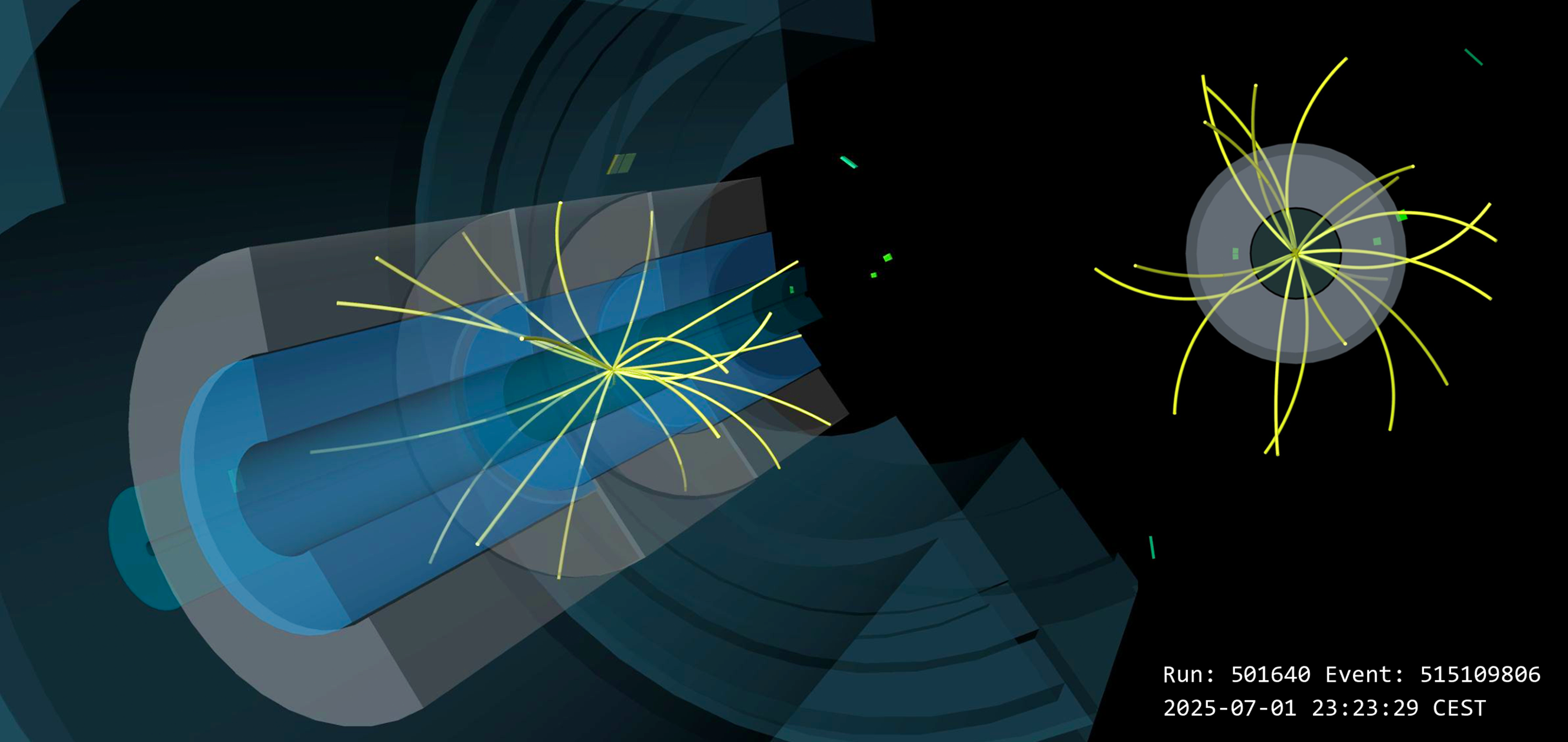
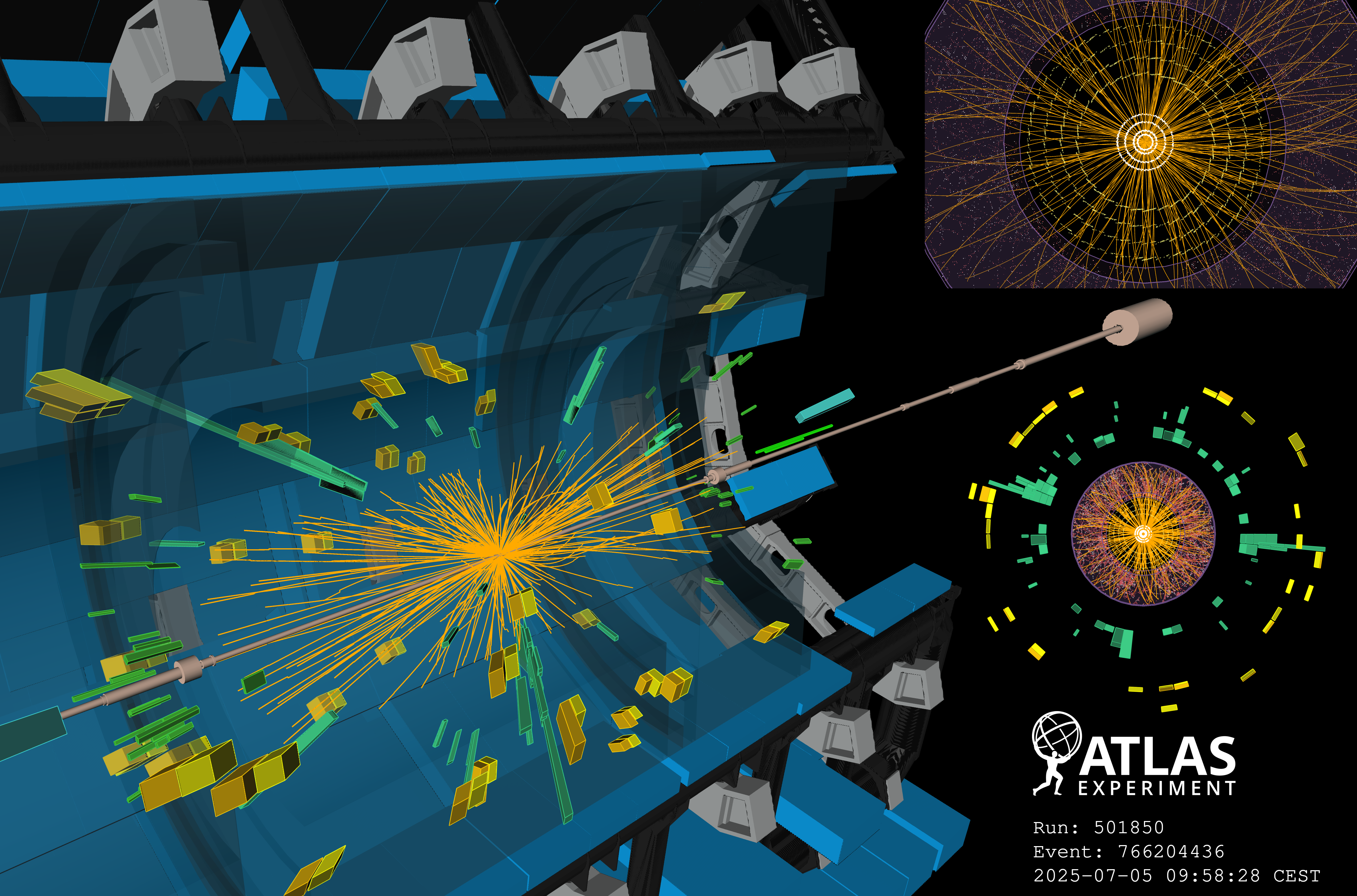
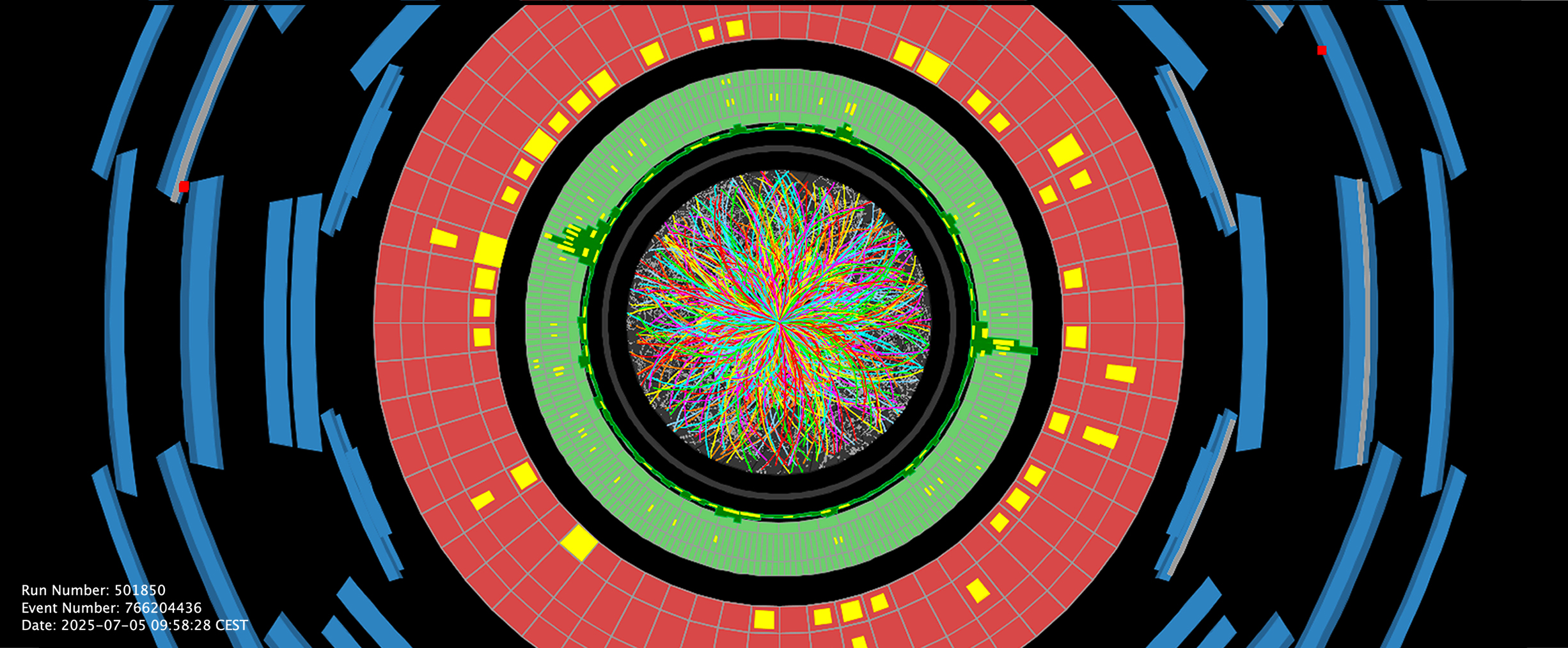
During the summer of 2025, the ATLAS experiment recorded its first-ever oxygen–oxygen and neon-neon collisions, opening a new window onto the study of the QGP. This extreme state of matter mimics the conditions of the early Universe during the first microseconds after the Big Bang. While QGP studies have traditionally focused on collisions of large nuclei such as lead or xenon, there is growing interest in probing smaller systems, such as oxygen or neon, to understand how QGP behaviour evolves with system size.

The QGP is typically characterised by two phenomena: hydrodynamic flow and partonic energy loss. Hydrodynamic flow occurs because the QGP behaves as a very low viscosity fluid and so the geometry of the initial collision is imprinted on the distributions of particles observed in the detector. Partonic energy loss occurs when high-energy quarks and gluons lose energy while traversing the medium. When this energy loss affects particle jets, the phenomenon is known as jet quenching.
Earlier analyses released last year showed that the QGP created in these light-ion collisions produced hydrodynamic flow and provided first measurements suggestive of jet quenching in oxygen–oxygen collisions. This week, the ATLAS Collaboration presented new results that extend this picture, reporting the first observation of jet quenching in both oxygen–oxygen and neon–neon collisions.
This is the first observation of jet quenching in oxygen–oxygen and neon–neon collisions at the LHC, and firmly establishes these as the smallest systems so far in which the phenomenon has been measured.


This milestone was achieved through studies of dijet momentum balance. In proton-proton collisions, pairs of particle jets (dijets) are typically produced back-to-back with nearly equal transverse momentum. In heavy-ion collisions, however, physicists have observed an increased number of imbalanced dijets arising from differences in the jets’ path length through the QGP (see Figure 1) and from fluctuations in the energy-loss process itself. Researchers quantify this imbalance using xJ, which is the ratio of the lower jet transverse momentum to the higher one. This phenomenon can then be mapped across different collision geometries, considering the degree of overlap of the colliding nuclei (their centrality). Head-on (central) collisions create the largest QGP droplets and show stronger jet quenching effects, manifesting in less balanced jets compared to the energy-loss-free proton baseline. Conversely, glancing (peripheral) collisions should create smaller droplets and show little to no jet quenching effects, with an xJ distribution similar to that seen in proton–proton collisions.

In their analysis of light-ion collisions, the ATLAS team successfully measured this effect. As shown in Figure 2, the gradual modification with increasing centrality is qualitatively compatible with the formation of QGP droplets of increasing transverse size inducing greater energy-loss effects on particle jets formed in the collisions. They then considered the modification in the xJ distributions relative to proton-proton collisions as a function of centrality and leading jet transverse momentum. Jet quenching was observed in central oxygen–oxygen and neon–neon collisions, with statistical significances exceeding the five standard deviations observation threshold (see Figure 3). Peripheral light-ion collisions were found to be most similar to proton–proton results, while the most central light-ion collisions showed xJ distributions similar to those seen in lead–lead collisions when they produce a similar size QGP droplet.
This is the first observation of jet quenching in oxygen–oxygen and neon–neon collisions at the LHC, and firmly establishes these as the smallest systems so far in which the phenomenon has been measured. It provides an important clue to help researchers pinpoint the system size at which QGP begins to affect high-energy jets. Future studies of these datasets will explore this phenomenon in greater detail, offering new insights into this exotic state of matter and informing plans for the heavy-ion programme in LHC Run 4 and beyond.
Learn more
- Observation of centrality-dependent dijet transverse momentum imbalance in O+O and Ne+Ne collisions at 5.36 TeV with the ATLAS detector (arXiv:2606.20463, see figures)
- Measurements of the suppression and correlations of dijets in Pb+Pb collisions at 5.02 TeV (Phys. Rev. C 107 (2023) 054908, arXiv:2205.00682, see figures)
- Measurement of jet pT correlations in Pb+Pb and pp collisions at 2.76 TeV with the ATLAS detector (Phys. Lett. B 774 (2017) 379, arXiv:1706.09363, see figures)
- Observation of a Centrality-Dependent Dijet Asymmetry in Lead-Lead Collisions at 2.76 TeV with the ATLAS Detector at the LHC (Phys. Rev. Lett. 105 (2010) 252303, arXiv:1011.6182, see figures)
- Giacalone et al., The unexpected uses of a bowling pin: exploiting 20Ne isotopes for precision characterizations of collectivity in small systems (arXiv:2402.05995)
- Hunting for jet quenching in collisions between oxygen nuclei, Physics Briefing, September 2025
- Bowling balls vs. bowling pins? ATLAS studies the unique shape of neon ions, Physics Briefing, September 2025
- ATLAS takes a breath of oxygen, ATLAS News, July 2025
- ATLAS gives new insight into dijet suppression in heavy-ion collisions. Physics Briefing, April 2022
- Looking inside trillion degree matter with ATLAS at the LHC, ATLAS Feature, May 2022