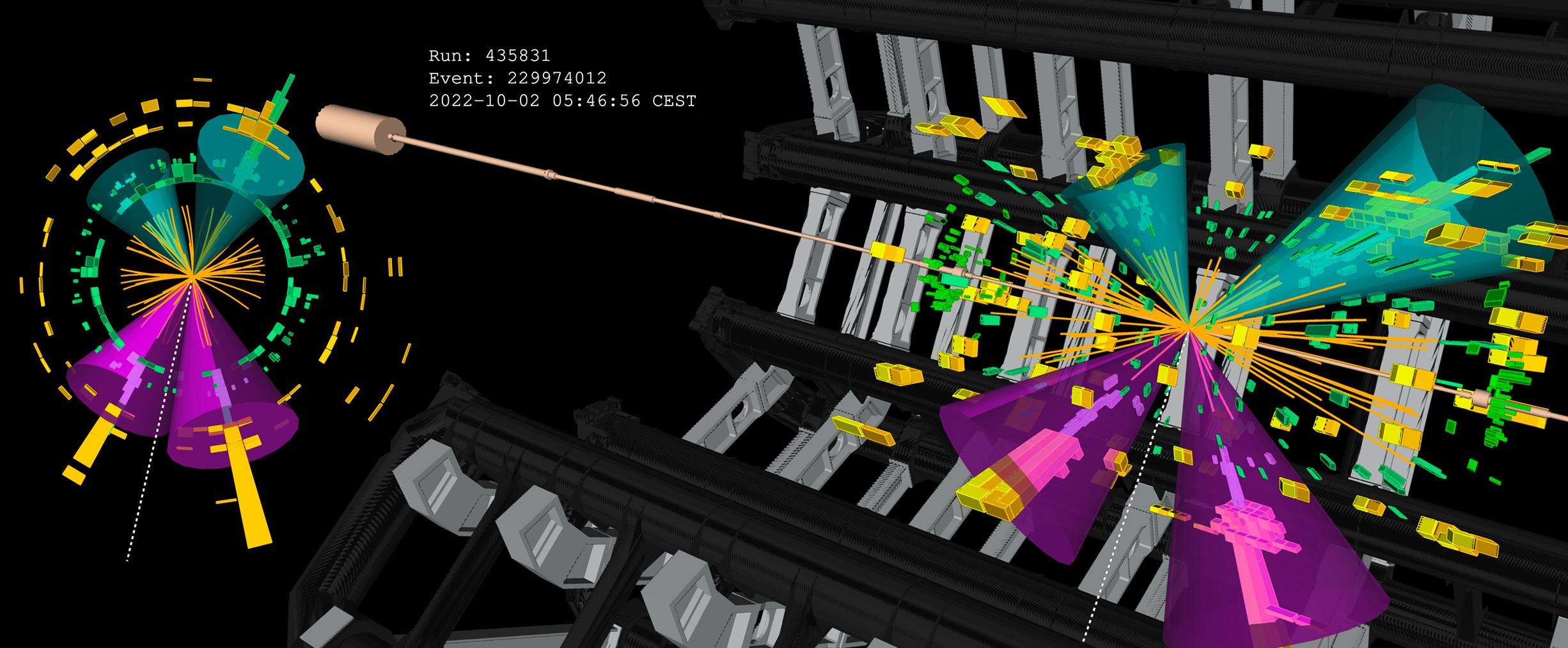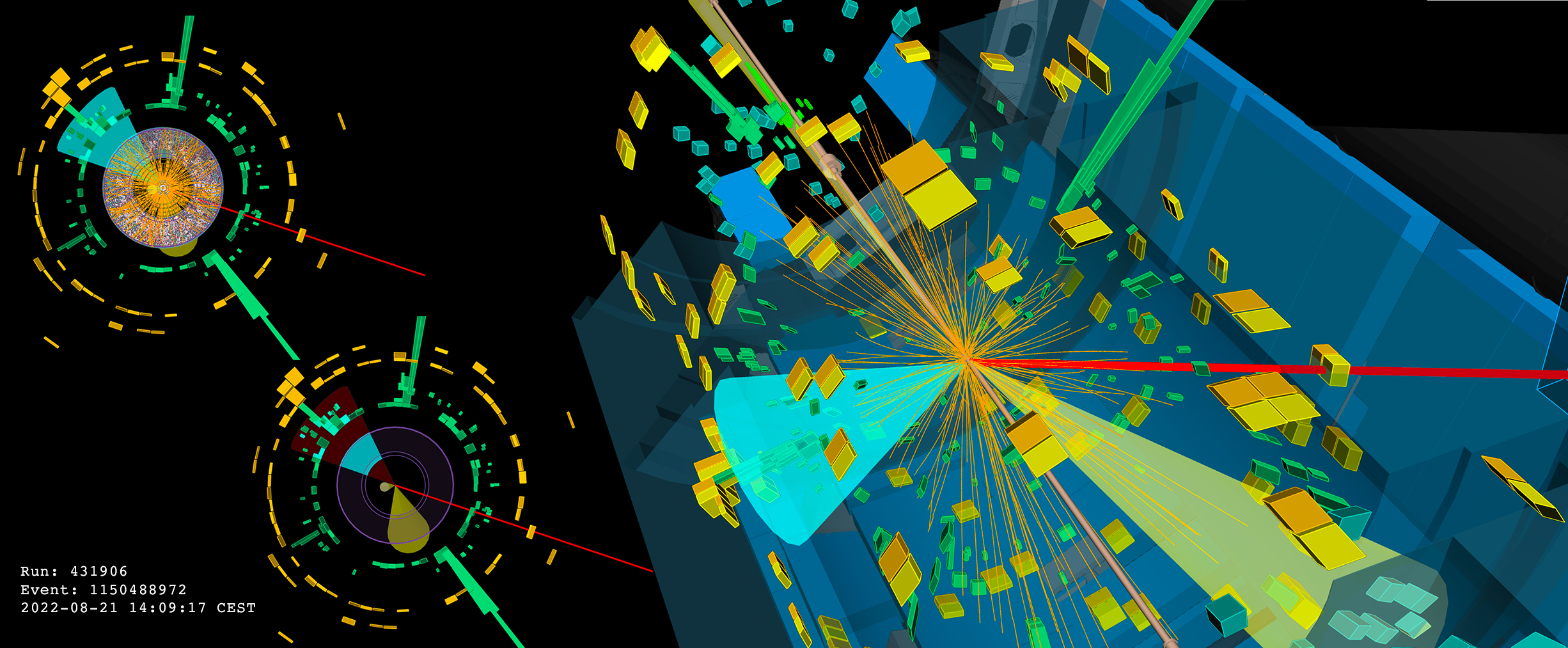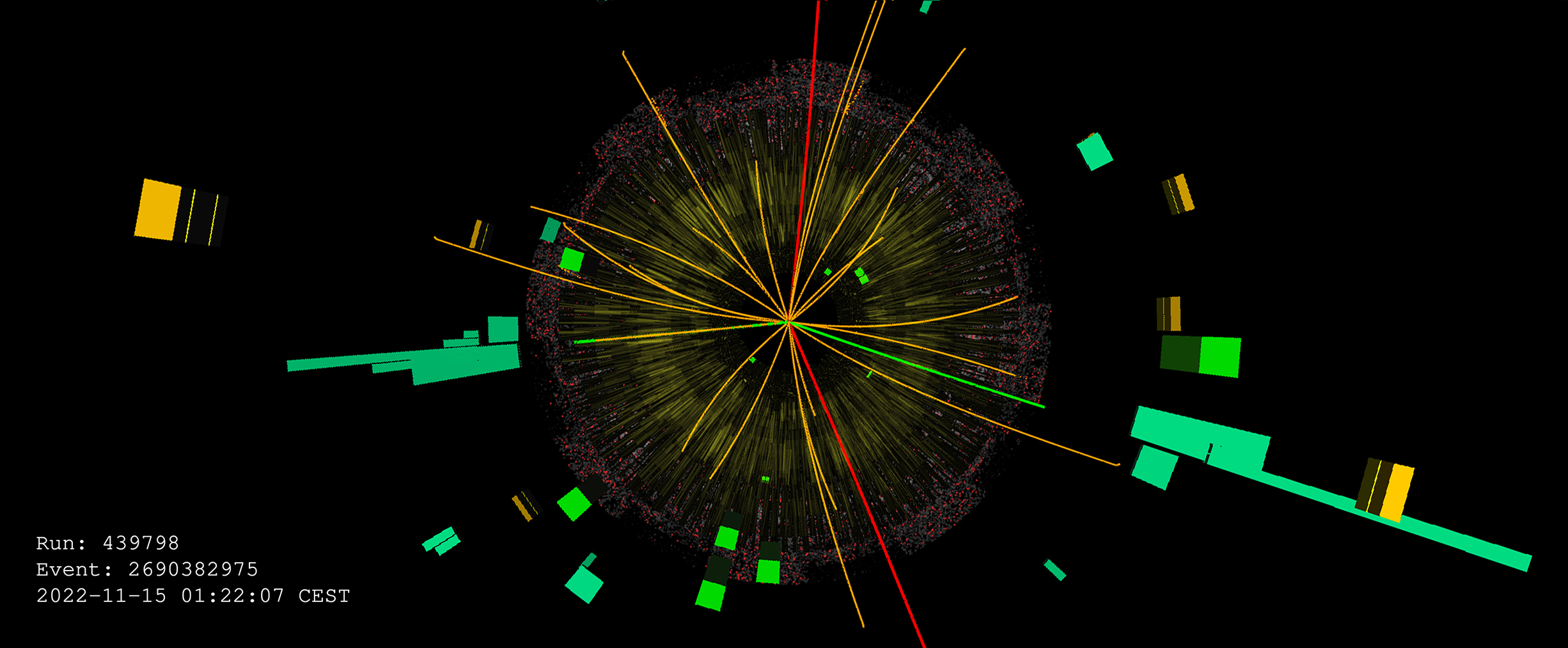
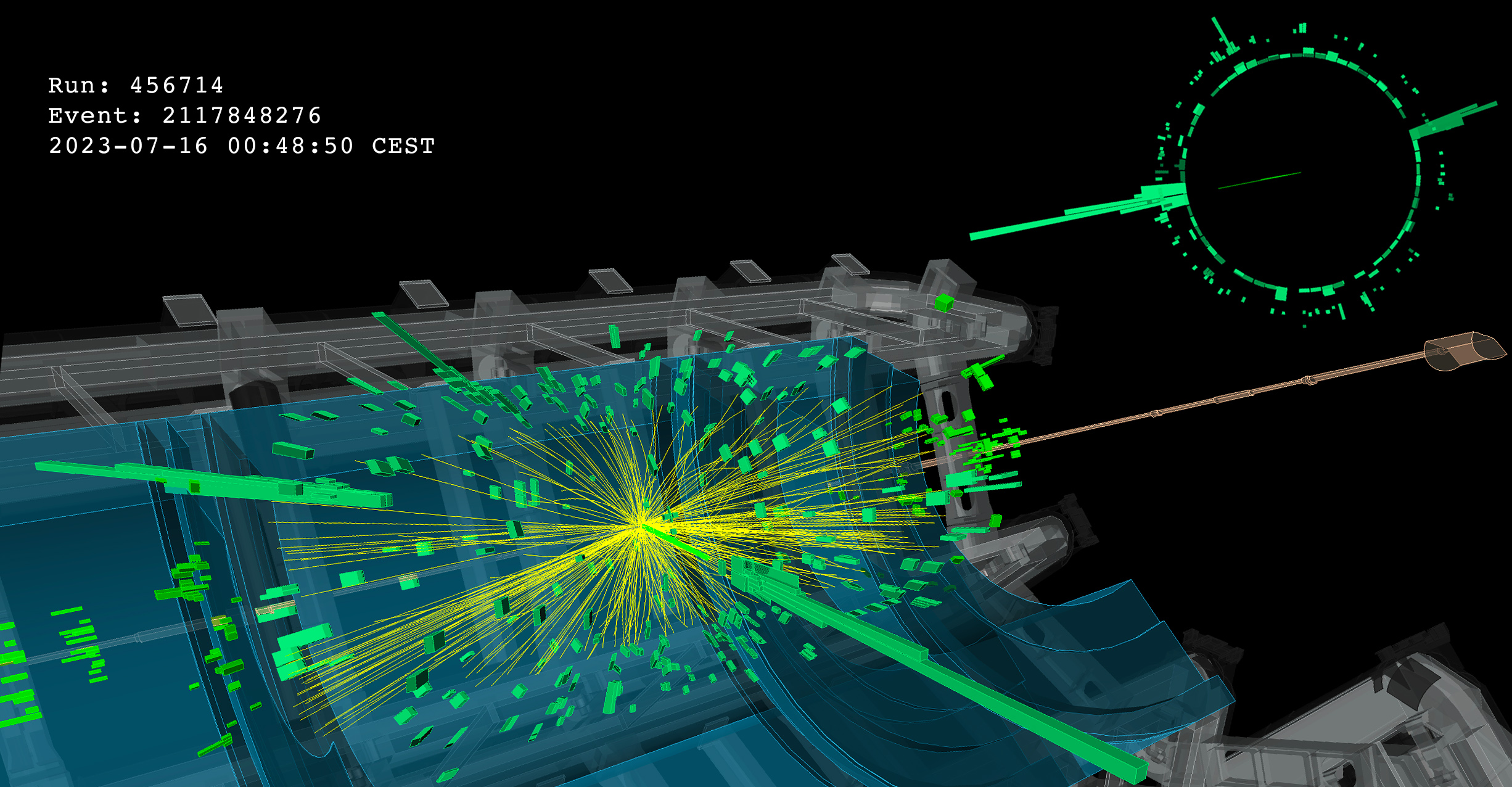
ATLAS finds evidence for one of the Higgs boson’s rarest decays
14 September 2026 | By
Every decay mode of the Higgs boson offers a different window into the fundamental laws of nature. Rare decays are particularly interesting as they provide unique opportunities to test the Standard Model in regimes where subtle effects of new physics could become visible. Recent studies of such rare Higgs-boson decays – including decays to a photon and a Z boson and to a pair of muons – have begun to unlock this potential, with more still to be explored.
One particularly elusive decay is the Higgs-boson decay to a virtual photon and a photon (H→γ*γ), which accounts for just one in about 10,000 Higgs decays. Unlike the familiar stable, massless photon, the virtual photon (γ*) exists only fleetingly, has a non-zero mass and decays instantly – in this case to two leptons (H→γ*γ→llγ, l=e, μ). Like the more common Higgs-boson decays to two photons (H→γγ) or to a Z boson and a photon (H→Zγ), H→γ*γ→llγ proceeds through quantum interactions involving virtual particles. The virtual photon provides an additional window into the Higgs boson’s properties. By decaying into a pair of charged leptons, it gives access to information not available when both photons are real, including new ways to test the Higgs boson’s CP properties.
The ATLAS Collaboration presented a new search for the H→γ*γ→llγ decay at the International Conference on High Energy Physics (ICHEP) 2026. Because this process is so rare, physicists combined the largest available datasets for this analysis: the first three years of LHC Run-3 data (collected in 2022–2024) and the full Run-2 dataset (collected in 2015–2018). This resulted in the most sensitive measurement of the H→γ*γ→llγ decay to date.
This result demonstrates the remarkable capabilities of the ATLAS experiment and the power of innovative analysis techniques, opening a window onto some of the Higgs boson's rarest decays.
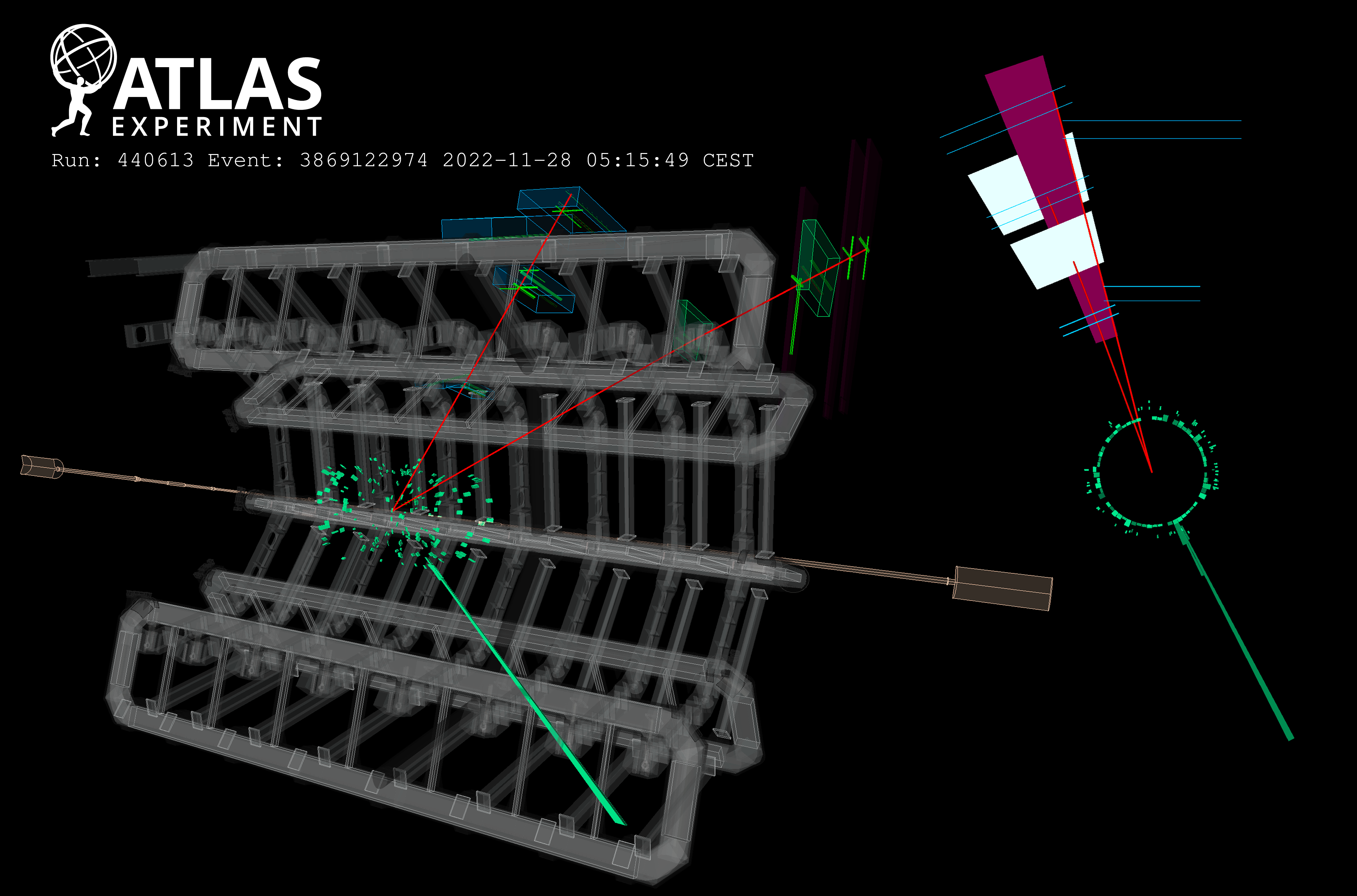
To achieve this result, ATLAS physicists looked for collision events containing a photon and a pair of electrons or muons (produced in the decay of a virtual photon). To distinguish this process from similar ones (like H→Zγ→llγ), the team focused on events where the mass of the lepton pair was below 30 GeV. At such low masses, the leptons are emitted very close to each other. While the ATLAS experiment can readily identify nearby muons, identifying two close-by electrons is extremely difficult. To address this, physicists developed specialised reconstruction techniques for these "merged-electron" signatures: they deployed a machine-learning algorithm based on a boosted decision tree to identify overlapping electrons, dedicated energy calibrations to improve their energy measurement and a specialised, online event-selection tool (or “trigger”).
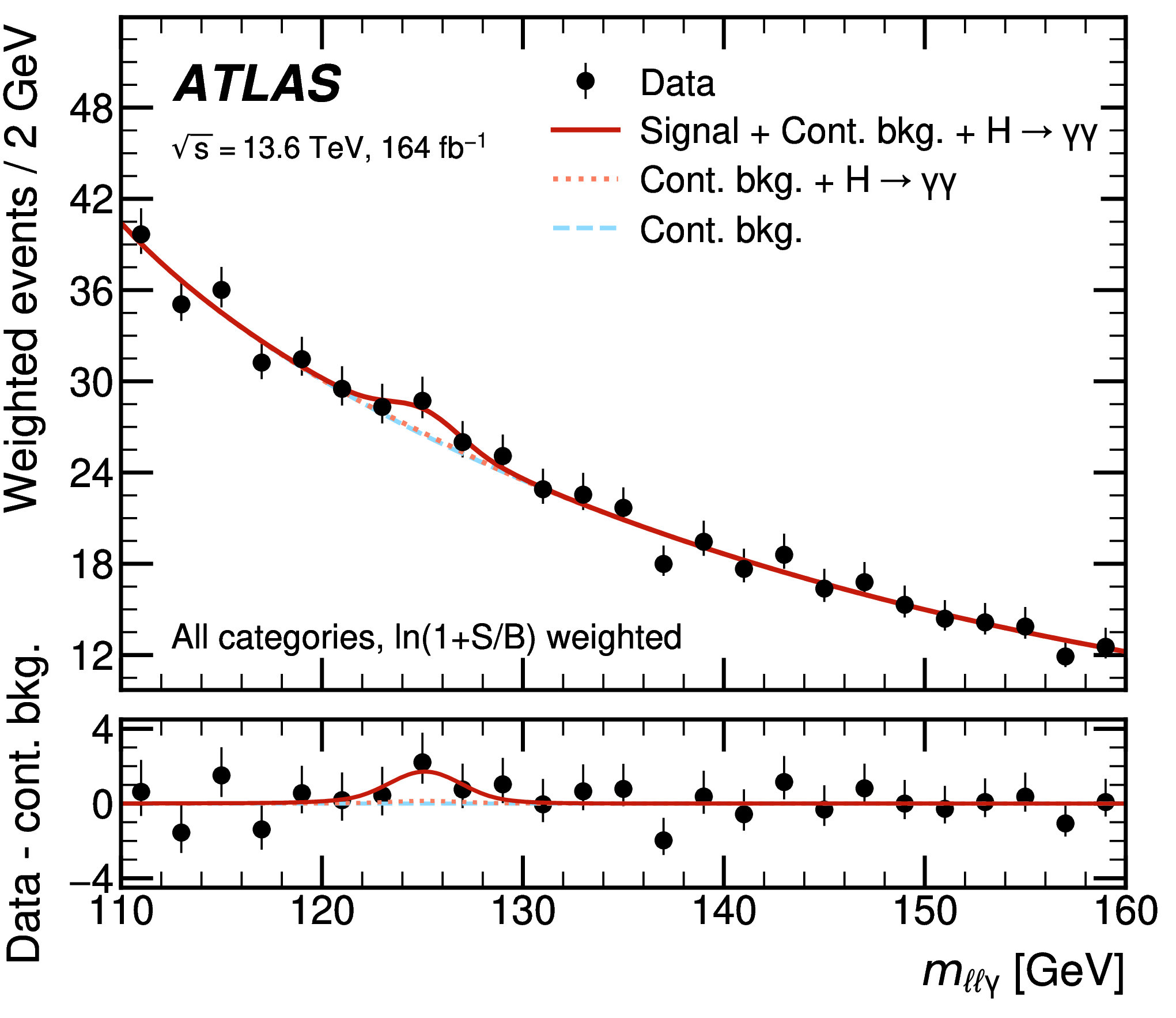
The Higgs-boson signal was extracted by searching for a small excess of events above the smooth background from other processes that leave the same experimental signature. As shown in Figure 1, this excess appears as a small bump around the Higgs-boson mass of 125 GeV. The previous ATLAS search using only Run-2 data showed some tension with the Standard Model, although large uncertainties left the picture inconclusive. By combining the Run-2 dataset with the newly available Run-3 data, roughly doubling the amount of data analysed, the ATLAS Collaboration measured a Higgs-boson signal rate that is 1.03 ± 0.34 times the Standard-Model expectation – now in excellent agreement with the Standard Model. This constitutes clear evidence of this rare decay mode! The chance that the measured signal could be caused by a fluctuation in the background is 3.4 standard deviations, corresponding to a probability of less than one in a thousand that the background alone could produce such an excess.
This result demonstrates the remarkable capabilities of the ATLAS experiment and the power of innovative analysis techniques, which allow physicists to explore some of the Higgs boson's rarest decays. As the High-Luminosity LHC era approaches, researchers will be able to explore these elusive processes with unprecedented precision, providing new opportunities to test the Standard Model and search for signs of new physics.
Learn more
- Measurements of the Higgs boson decay to a low-mass dilepton system and a photon in proton–proton collisions at 13 and 13.6 TeV with the ATLAS detector (submitted to JHEP, arXiv:2608.03369, see figures)
- Evidence for Higgs boson decays to a low-mass dilepton system and a photon in pp collisions at 13 TeV with the ATLAS detector (Phys. Lett. B 819 (2021) 136412, arXiv:2103.10322, see figures)
- ICHEP 2026 presentation by Laura Nasella: Search for rare and lepton-flavor-violating Higgs boson decays at the ATLAS experiment
- CHEP 2026 presentation by Kerstin Tackmann: ATLAS highlights