ATLAS takes the top–Z partnership to the next differential
20 October 2026 | By
More than 30 years after its discovery, the top quark continues to intrigue. Weighing in at approximately 173 GeV – as much as a gold atom – it is the heaviest known fundamental particle in the Standard Model. This extraordinary mass could make it sensitive to as-yet-unknown particles or interactions at energy scales beyond the reach of the LHC. If such new physics phenomena exist, they could leave subtle fingerprints in how top quarks are produced and decay.
Of particular interest is the rare production of a single top quark in association with a Z boson and an additional jet, known as tZq. The process was observed in 2019 and 2020 by the CMS and ATLAS Collaborations. In addition to establishing tZq production, that initial ATLAS measurement used the full LHC Run-2 dataset (collected 2015–2018) to determine its total production rate, or cross section, with a 15% uncertainty.

Now, ATLAS researchers have revisited the full Run-2 dataset to achieve the most precise measurement of the tZq cross section to date. For the first time, they have also measured its differential cross sections, which describe how tZq events are distributed according to properties such as particle momenta and directions.
A seven-year itch? Not for the tZq partnership
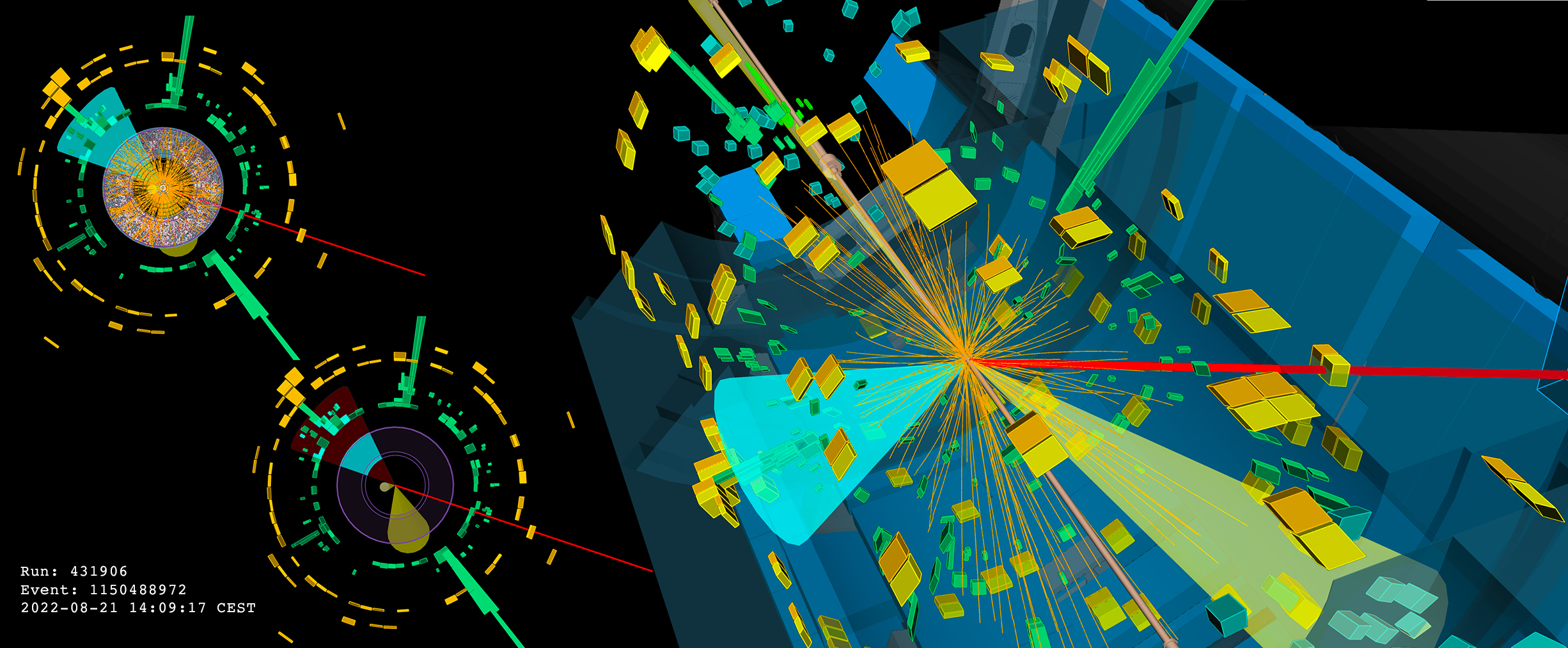
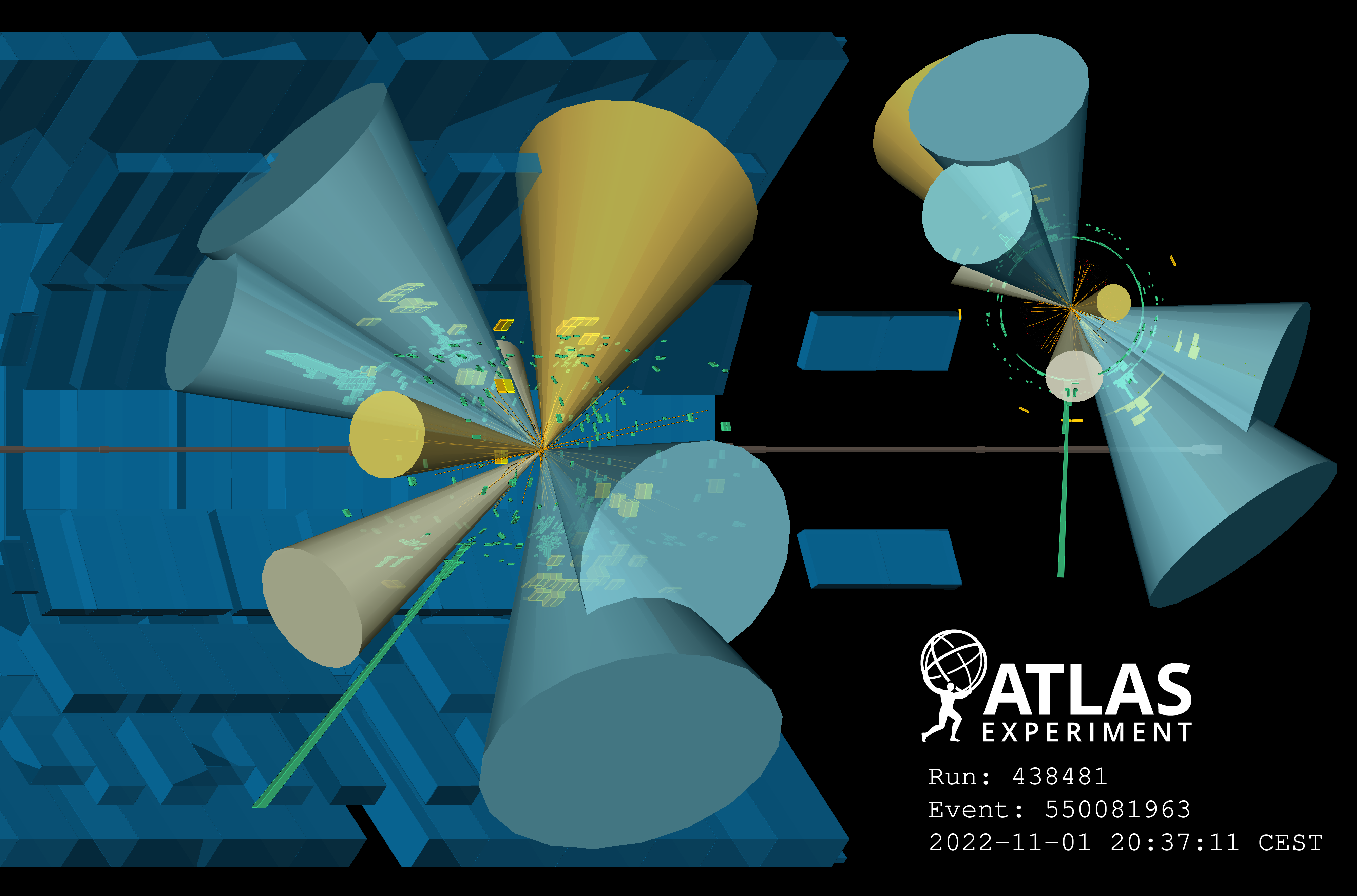
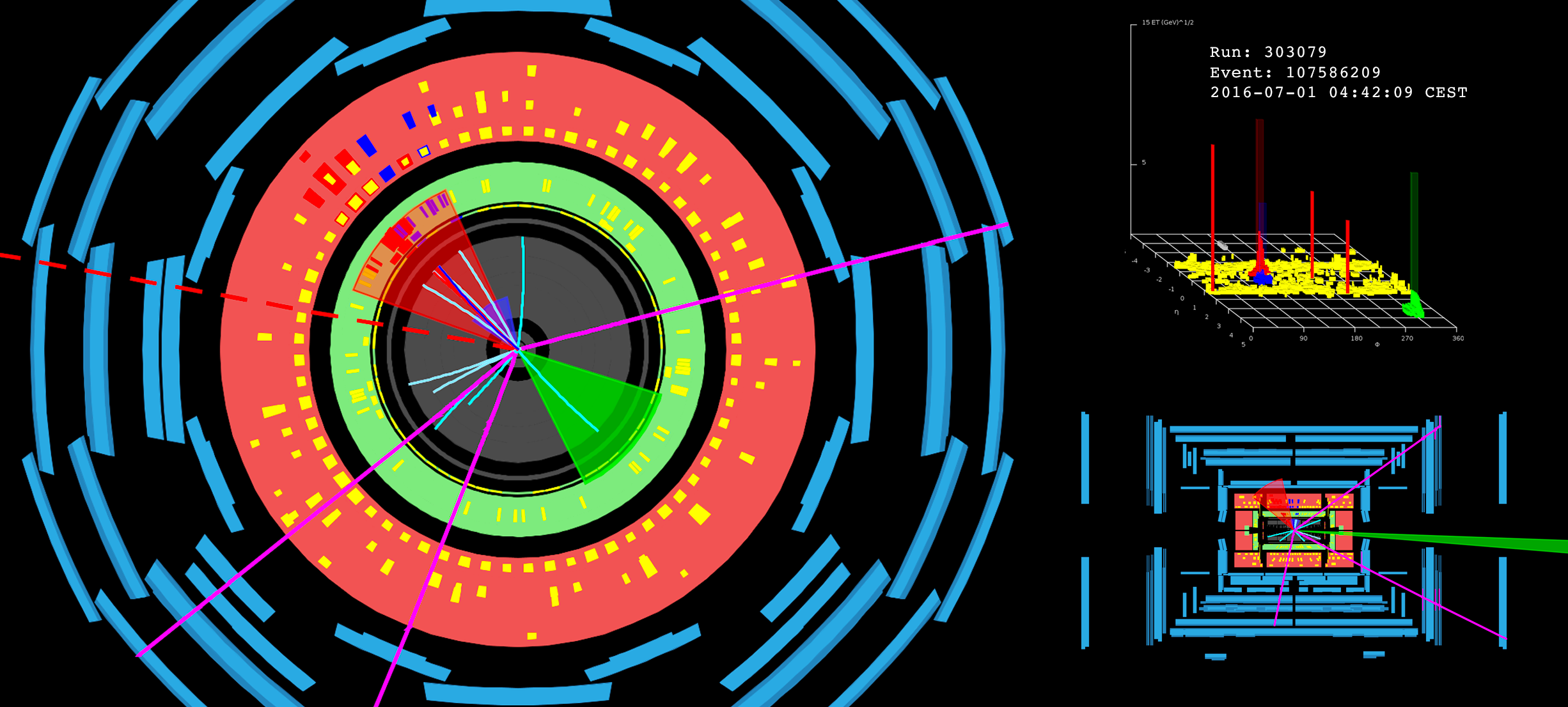
For their new analysis, researchers targeted tZq events in which the Z boson decays into two electrons or muons, while the top quark decays into a W boson and a bottom quark. The W boson produces an electron or muon, and a neutrino that escapes the detector unseen. The resulting signature is distinctive (see banner image): three isolated charged leptons, a jet of particles originating from a b-quark and an additional jet, characteristic of the electroweak production that leads to the production of a single top in the event.
To improve the precision of the cross section, physicists reprocessed the dataset using the improved event reconstruction and identification algorithms, and loosened the event selection criteria to include more potential signal events. Events with exactly three isolated leptons and two to four jets, of which one or two originate from a b-quark, were selected. Only 2084 events out of the more than 20 billion collisions recorded by ATLAS passed this selection. Of these, around 320 are expected to originate from tZq production, with the rest coming from background processes that leave similar signatures.
The ATLAS Collaboration has achieved the most precise measurement of the tZq production cross section to date, cementing this rare process into the Standard-Model puzzle.
To separate the signal from these backgrounds, researchers used a deep neural network trained on simulations of both. The network combined information about particle energies, momenta and directions to identify subtle differences between signal and background, assigning each event a score indicating how signal-like it is (see Figure 1).
The ATLAS Collaboration measured the tZq cross section to be 95.2 fb with an 10% uncertainty, most of which comes from the relatively small number of signal events in the data. This is the most precise tZq cross-section measurement to date. The collaboration also measured differential cross sections for several kinematic variables. Using a statistical procedure known as unfolding to account for detector distortions and inefficiencies, the team was able to compare the measured distributions directly with theoretical predictions. These were found to be in agreement within uncertainties (see Figure 2).
More fish in the sea? Casting a wider net for new physics

The results were also interpreted using the Standard Model Effective Field Theory (SMEFT) framework, which allows researchers to search for possible new interactions without committing to a particular theory beyond the Standard Model. Such effects may become more visible in the relatively small number of events produced at the highest energies.
No significant deviation from the Standard Model was observed. The data were used to constrain eight parameters, known as Wilson coefficients, which describe the possible strength of new interactions. These results can be combined with other measurements in future global studies of physics beyond the Standard Model.
With this precise new result, the ATLAS Collaboration has cemented the tZq process into the Standard-Model puzzle. The much larger dataset collected during LHC Run 3 will allow future measurements to reach even greater precision, providing new sensitivity to potential deviations from the Standard Model.
Learn more
- Measurement of tZq inclusive and differential cross-sections in proton-proton collisions at 13 TeV with the ATLAS detector (arXiv:2608.25476, see figures)
- Observation of the associated production of a top quark and a Z boson in proton-proton collisions at 13 TeV with the ATLAS detector (JHEP 07 (2020) 124, arXiv: 2002.07546, see figures)
- CMS Collaboration: Observation of single top quark production in association with a Z boson in proton-proton collisions at 13 TeV (Phys. Rev. Lett. 122 (2019), 132003, arXiv: 1812.05900)
- CMS Collaboration: Inclusive and differential cross section measurements of single top quark production in association with a Z boson in proton-proton collisions at 13 TeV (J. High Energ. Phys. 2022, 107 (2022), arXiv: 2111.02860)
- 25 years on: a single top quark partners with the Z boson, Physics Briefing, February 2020