ATLAS explores quantum entanglement using Higgs boson decays, while charting its properties
5 June 2026 | By
At the ATLAS experiment at CERN, physicists are using the Higgs boson as a testbed for complex quantum phenomena at high energy. Their latest results deliver precise measurements of Higgs-boson properties and provide the first strong evidence of quantum entanglement between two massive vector bosons.
Exploring the "Golden Channel"
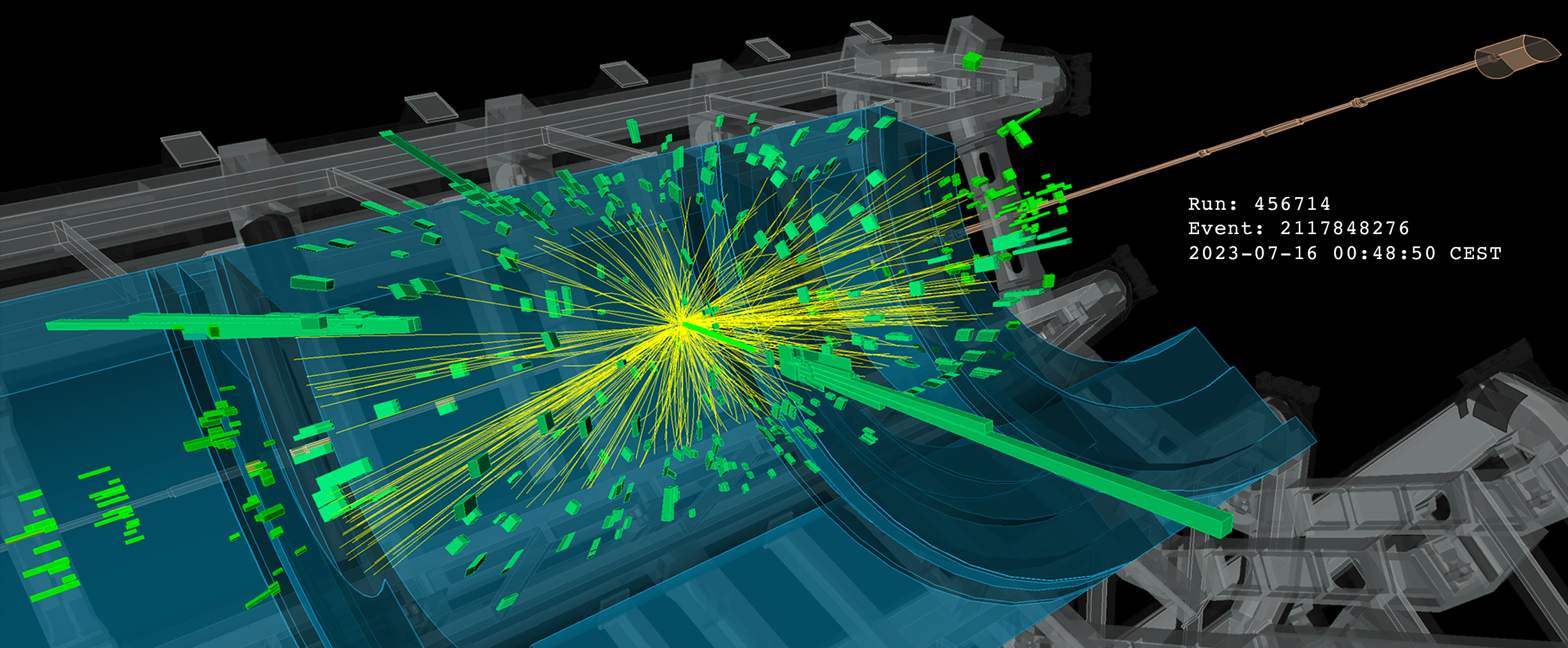
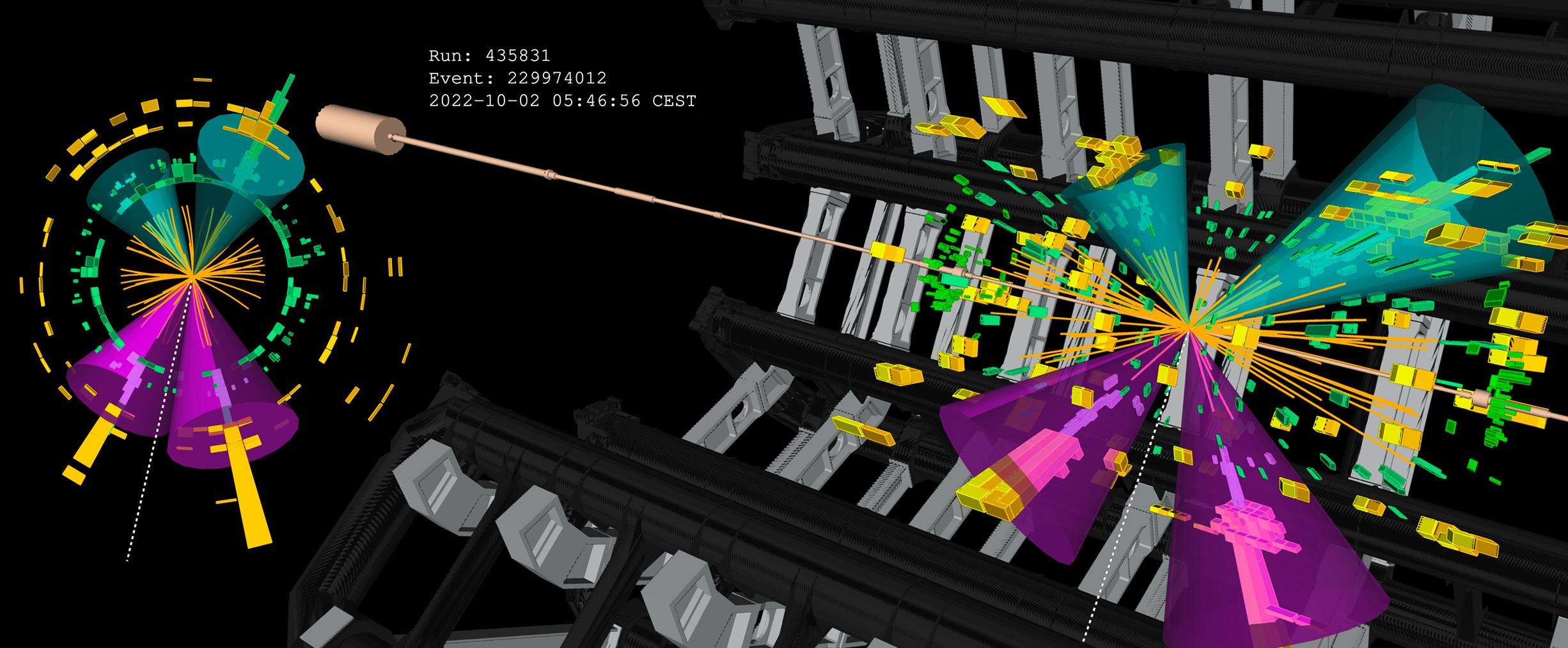
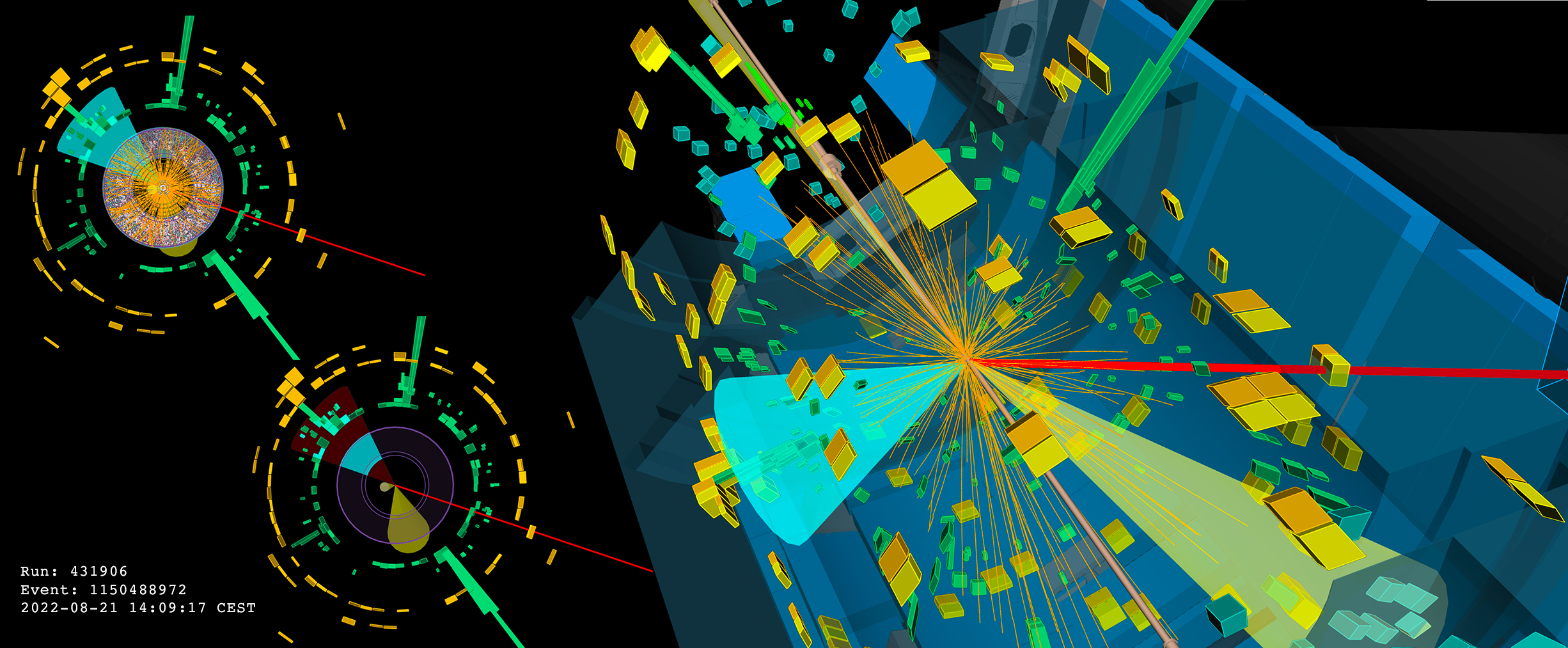
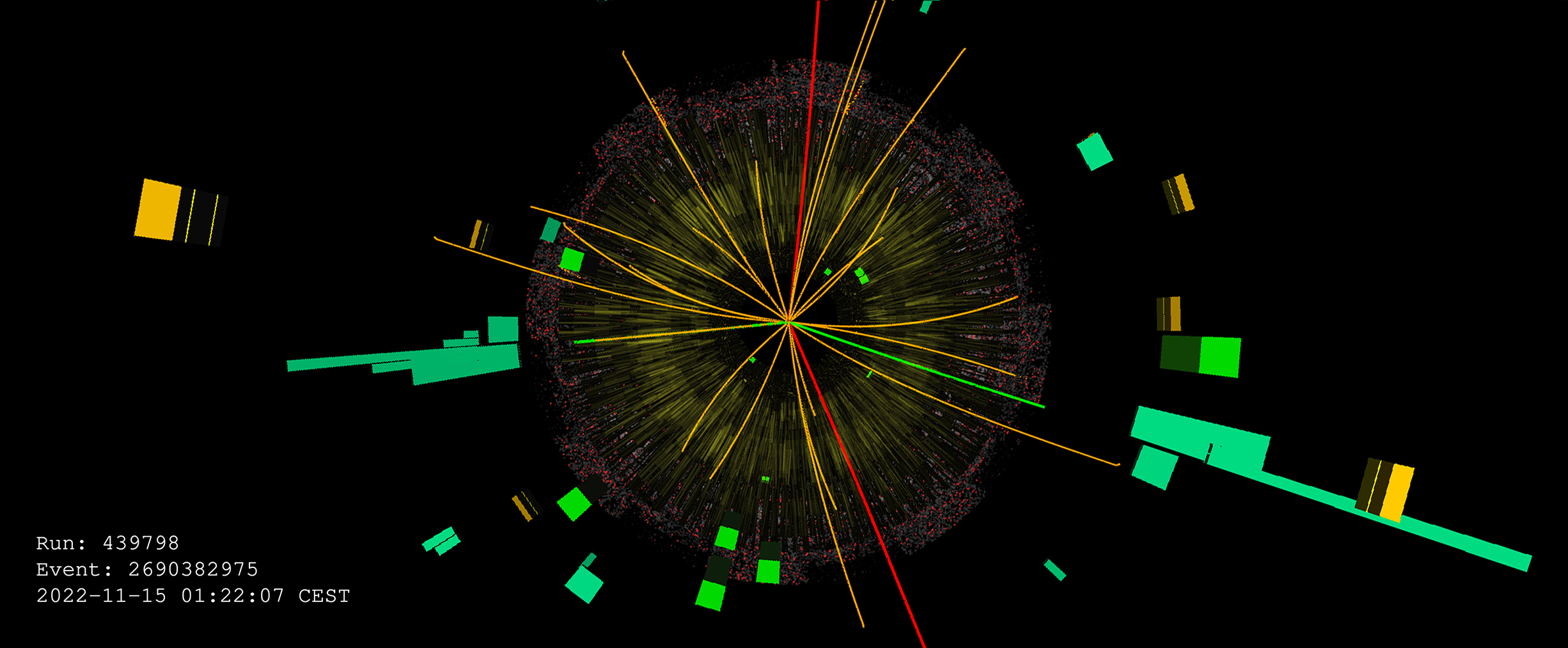
In an updated study, ATLAS physicists examined the rare H → ZZ* → 4ℓ decay process, where a Higgs boson decays into two Z bosons – one of which is a lower-mass state (denoted by the asterisk). These Z bosons then decay into four leptons (electron or muon pairs).
While this process accounts for just ~3% of Higgs decays, it is ideal for precision measurements. The ATLAS experiment was specifically designed to identify and measure electrons and muons with high efficiency and precision, allowing the four-lepton final state to be fully reconstructed. Further, very few background processes mimic this signature. These features earned H → ZZ* → 4ℓ the nickname of “the golden channel”, and it was one of the two key signatures that enabled the ATLAS Collaboration’s discovery of the Higgs boson in 2012.
Researchers analysed three years of Run-3 proton–proton collision data collected at a centre-of-mass energy of 13.6 TeV between 2022 and 2024. Figure 1 shows the number of H → ZZ* → 4ℓ candidate events measured in this period. The primary goal was to measure the Higgs-boson production rate (cross section), and compare the results with predictions from the Standard Model of particle physics. Several complementary measurements were performed: the fiducial cross section, the Higgs-boson production rate measured within the coverage of the ATLAS detector; differential fiducial cross sections, the Higgs-boson production rate as a function of eight variables sensitive to its production and decay kinematics; and production cross sections, the Higgs-boson production rate in each of its four main production modes – via gluon fusion (ggF), vector boson fusion (VBF), associated production with a vector boson (VH) or a top-quark pair (ttH).


All cross-section measurements were found to be in agreement with the Standard-Model predictions, with a result precision rivalling previous ATLAS measurements performed with 13 TeV data. The fiducial cross-section was measured to be σfid = 3.65 ± 0.35 fb, agreeing with the Standard Model prediction of 3.68 ± 0.17 fb. The observed production cross-sections are compared to the Standard Model prediction, as shown in Figure 2. Researchers also used these measurements to constrain possible anomalous Higgs boson interactions caused by new physics phenomena within an Effective Field Theory framework and the κ-framework.
These new results sharpen our understanding of Higgs-boson properties and provide the first strong evidence of quantum entanglement between two massive vector bosons.
Entangled bosons
Quantum entanglement – where the state of one particle cannot be described independently of another – is one of the most mind-bending features of quantum mechanics. Traditionally studied in low-energy experiments, entanglement has recently been put to the test at the LHC's high-energy scales. In 2023, the ATLAS Collaboration achieved the first-ever observation of quantum entanglement between quarks, detecting it in top-antitop pairs at their production threshold. Now, the ATLAS experiment’s exceptional sensitivity to the H → ZZ* → 4l decay channel has enabled physicists to explore this frontier in pairs of massive vector bosons.
The Higgs boson is unique for having a spin of zero. The Z boson, by contrast, is a spin-1 particle, meaning it can exist in three possible polarisation states, corresponding to spin projections of +1, 0, or −1 along a chosen direction. The polarisation of two Z bosons describes how their spin states are correlated. When a Higgs boson decays into two Z bosons, the pair must conserve the Higgs boson’s total spin of zero. By studying these polarisation correlations, physicists can perform a precise test for both electroweak interactions and quantum entanglement.
The new analysis looked at combined data from LHC Run 2 at 13 TeV together with the three years of 13.6 TeV data described above. Researchers measured two parameters, C2,1,2,−1 and C2,2,2,−2, which describe correlations between the spin states of the Z-boson pair. A non-zero value for either parameter would signal quantum entanglement. The ATLAS team also compared their data to two possible scenarios: the Standard Model prediction, in which the Z bosons are entangled, and an alternative non-entangled scenario, where the entanglement-sensitive parameters would be zero.


The distributions of entanglement-sensitive observables agree well with the Standard Model and are inconsistent with a non-entangled hypothesis (see Figure 3). From these distributions, the mean values of the entanglement-sensitive parameters were measured to be C2,1,2,−1 =−0.71 ± 0.45 (compared with an expected Standard-Model value of −0.97 ± 0.47) and C2,2,2,−2 = 0.08 ± 0.44 (0.64 ± 0.43 expected), where uncertainties are dominated by statistical errors. Researchers carried out a complementary likelihood-ratio test using the C2,2,2,−2 distribution, relying on several Standard-Model assumptions in the decays, which provided substantially higher sensitivity to quantum correlations. This test rejected the non-entangled hypothesis with an observed significance of 4.7 standard deviations (4.9 expected). Together, these results provide strong evidence for quantum entanglement between the two massive Z bosons produced in Higgs-boson decays.
This result highlights the Higgs boson’s unique role as a natural laboratory for studying quantum entanglement at high energies, opening broad opportunities in future spin studies of Z bosons as well as in other decay channels.
Learn more
- Measurements of the Higgs boson production, fiducial and differential cross-sections in the four lepton decay channel using 164 fb-1 of data collected at 13.6 TeV with the ATLAS detector (arXiv:2605.19016, see figures)
- Measurements of Z-boson pair entanglement in decays of Higgs bosons at the ATLAS experiment (arXiv:2603.26463, see figures)
- Rencontres de Moriond presentation by Lailin Xu: Recent Single Higgs Measurements with the ATLAS Detector
- QOfCP2026 presentation by Tairan Xu: Measurements of Z-boson pair entanglement in decays of Higgs bosons at the ATLAS experiment
- ATLAS achieves highest-energy detection of quantum entanglement, Physics Briefing, September 2023
- Aguilar-Saavedra, J. A., et al., Testing entanglement and Bell inequalities in 𝐻 →𝑍𝑍 (Phys. Rev. D 107 (2023) 016012)