ATLAS tackles a new double-Higgs frontier
2 June 2026 | By
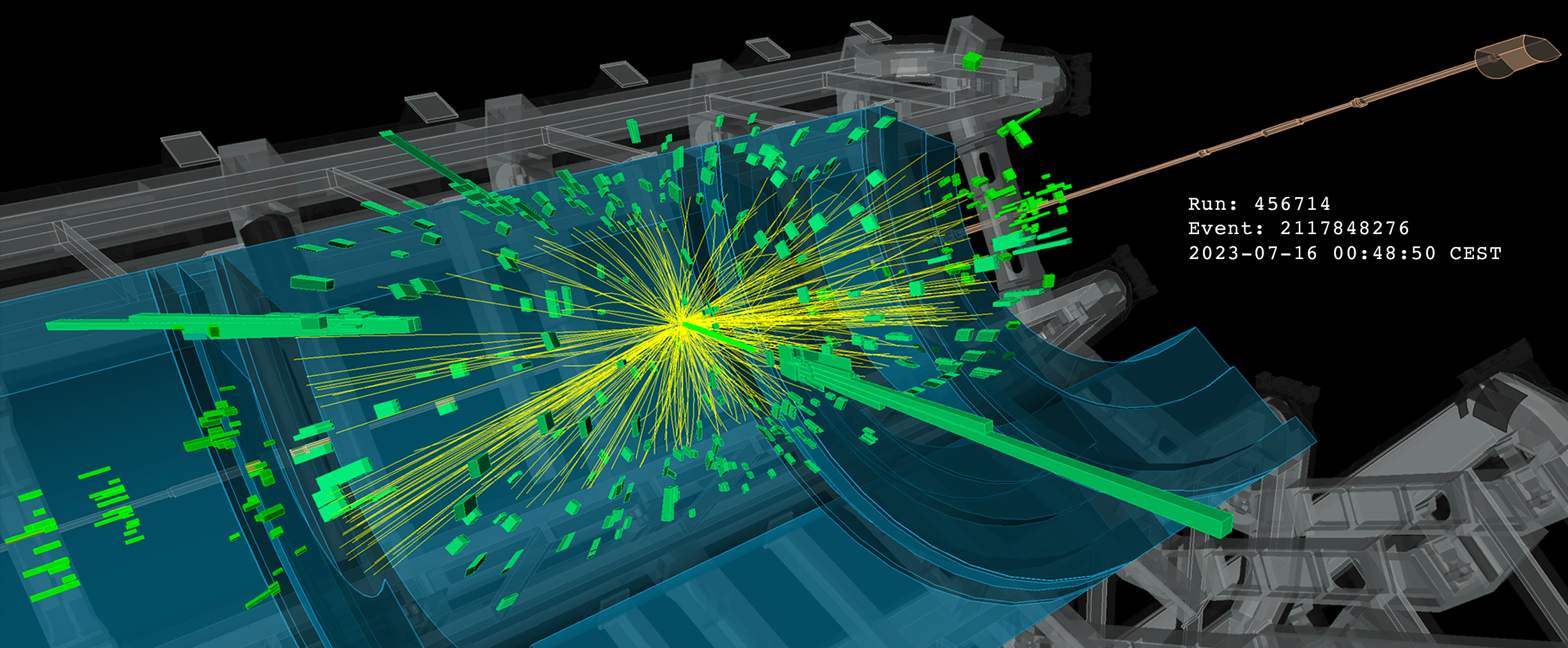
The ATLAS Experiment is on the hunt for “ttHH production" – an extremely rare process where two top quarks and two Higgs bosons pop out of a single collision.
More than a decade after the discovery of the Higgs boson, the ATLAS Collaboration is pushing into a new frontier in Higgs research: first evidence of di‑Higgs production. This process, in which two Higgs bosons are produced simultaneously, is incredibly rare. Its observation is a flagship goal for the High-Luminosity LHC (HL-LHC), as it holds the key to the Higgs boson’s self‑interaction – a property that can shed light on the origin and evolution of the universe.
The ATLAS Collaboration has launched its first search for ttHH production, one of the rarest di-Higgs production modes. The analysis uses the full LHC Run 2 dataset (collected during 2015-2018) and early Run 3 data (collected 2022-2023), looking for any hints that these particles are interacting in ways current theories don’t expect.
Tracking ten objects at once
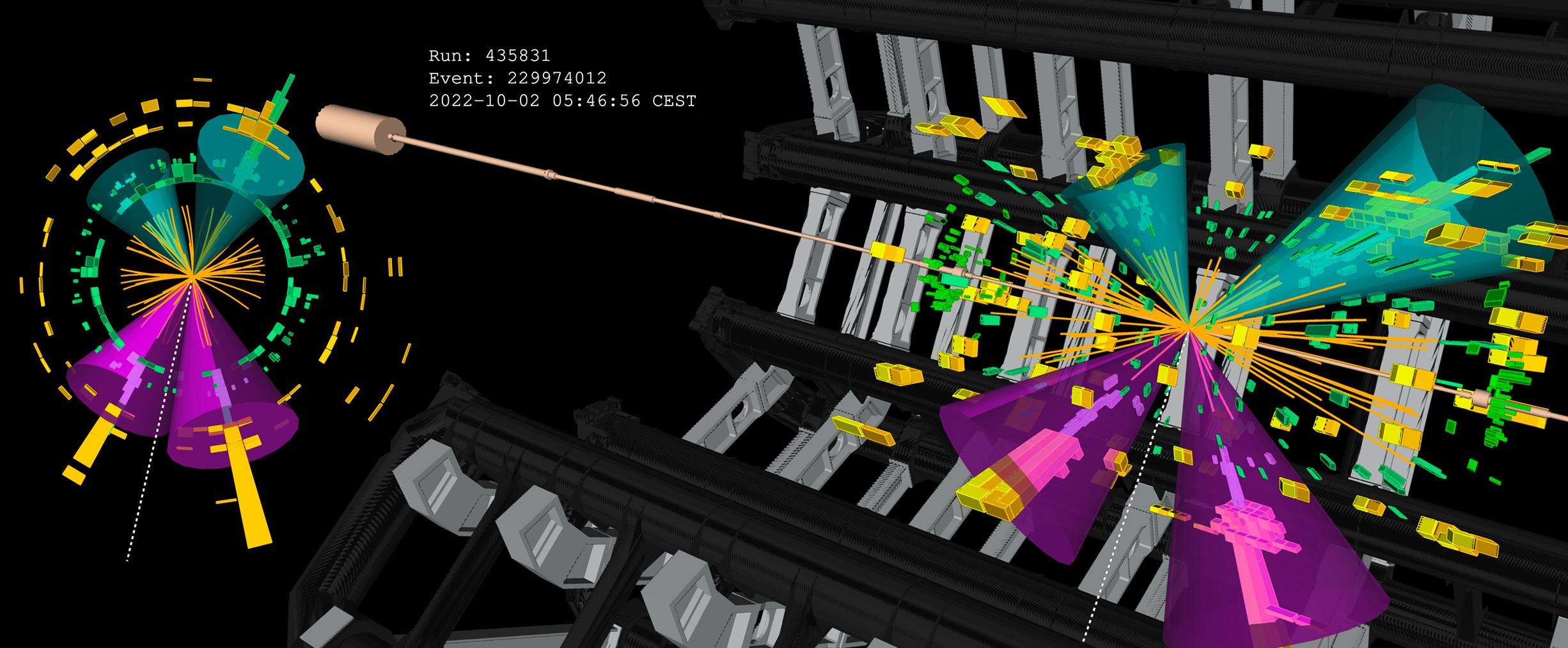
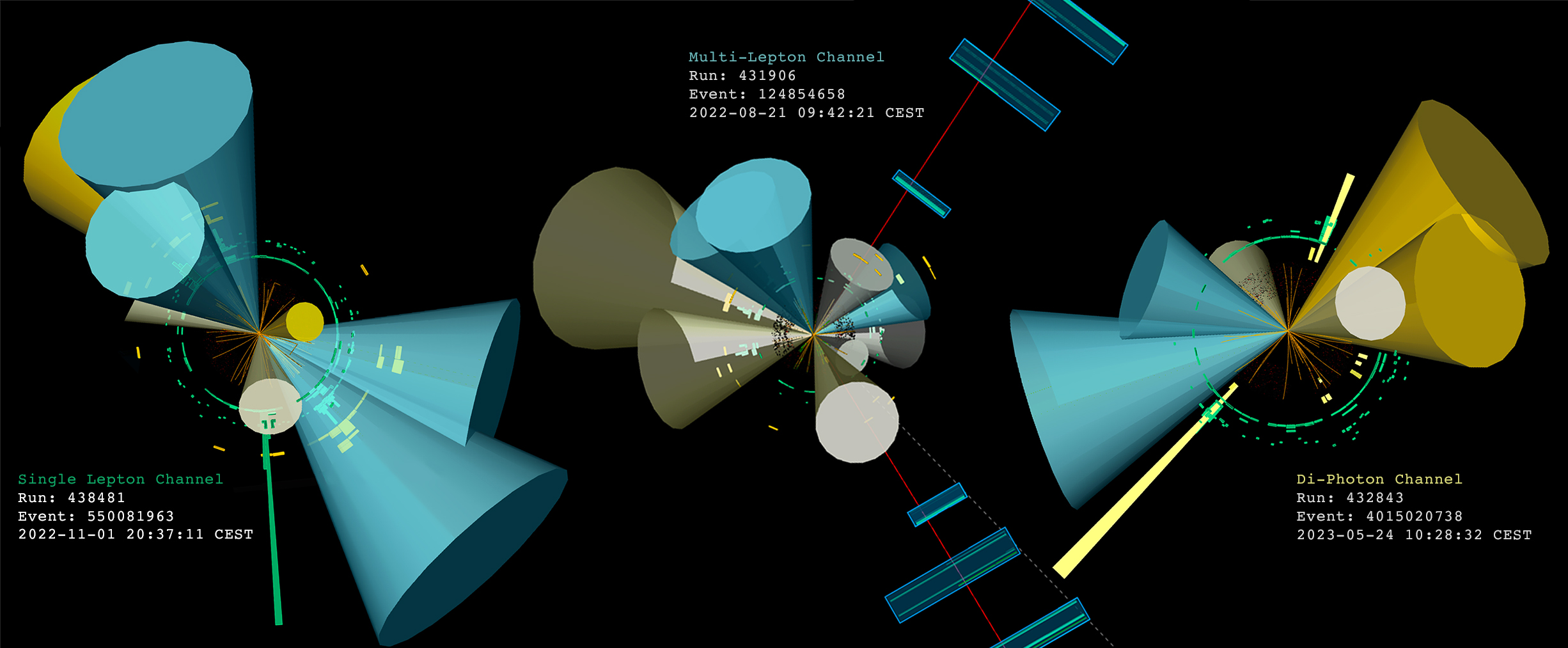
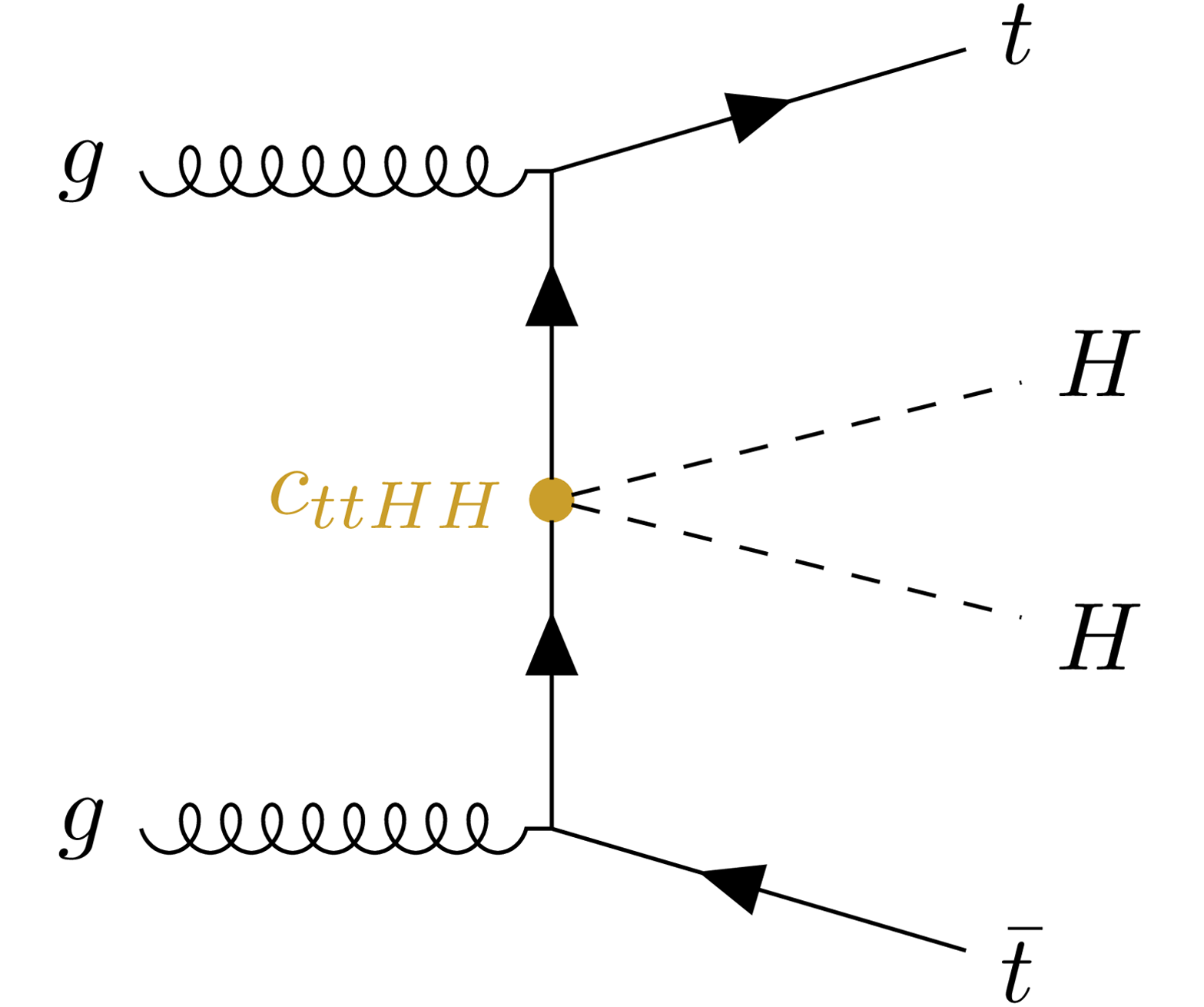
Of the many di-Higgs production modes, ttHH stands out as the most complex (see Figure 1). Top quarks and Higgs bosons are heavy and unstable, decaying almost immediately into a chaotic spray of leptons, photons and particle “jets” (see banner image). This makes it incredibly hard to reconstruct what happened in the collision.
But that’s also where this analysis can shine. Over the past several years, the ATLAS Collaboration has developed new detector calibration and event reconstruction methods to achieve precise identification of leptons, photons and jets (particularly those arising from bottom quarks). A single ttHH event can contain around ten well-reconstructed physics objects, providing many correlated clues to help researchers identify a potential signal. The downside? Background processes in these busy events are much more difficult to simulate, as combinatorial complexity and detector effects can mimic signals. Researchers developed advanced strategies to constrain these effects.
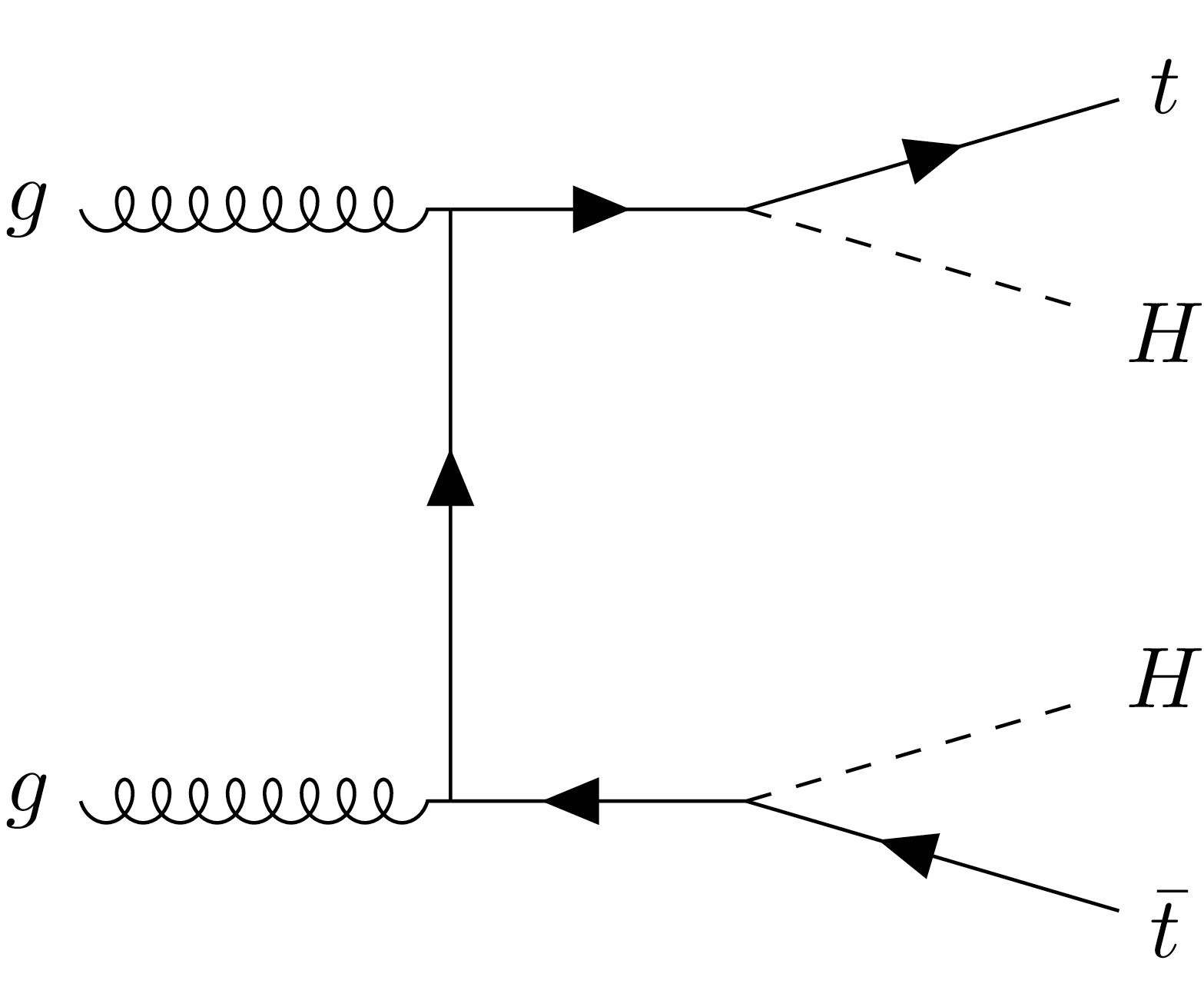
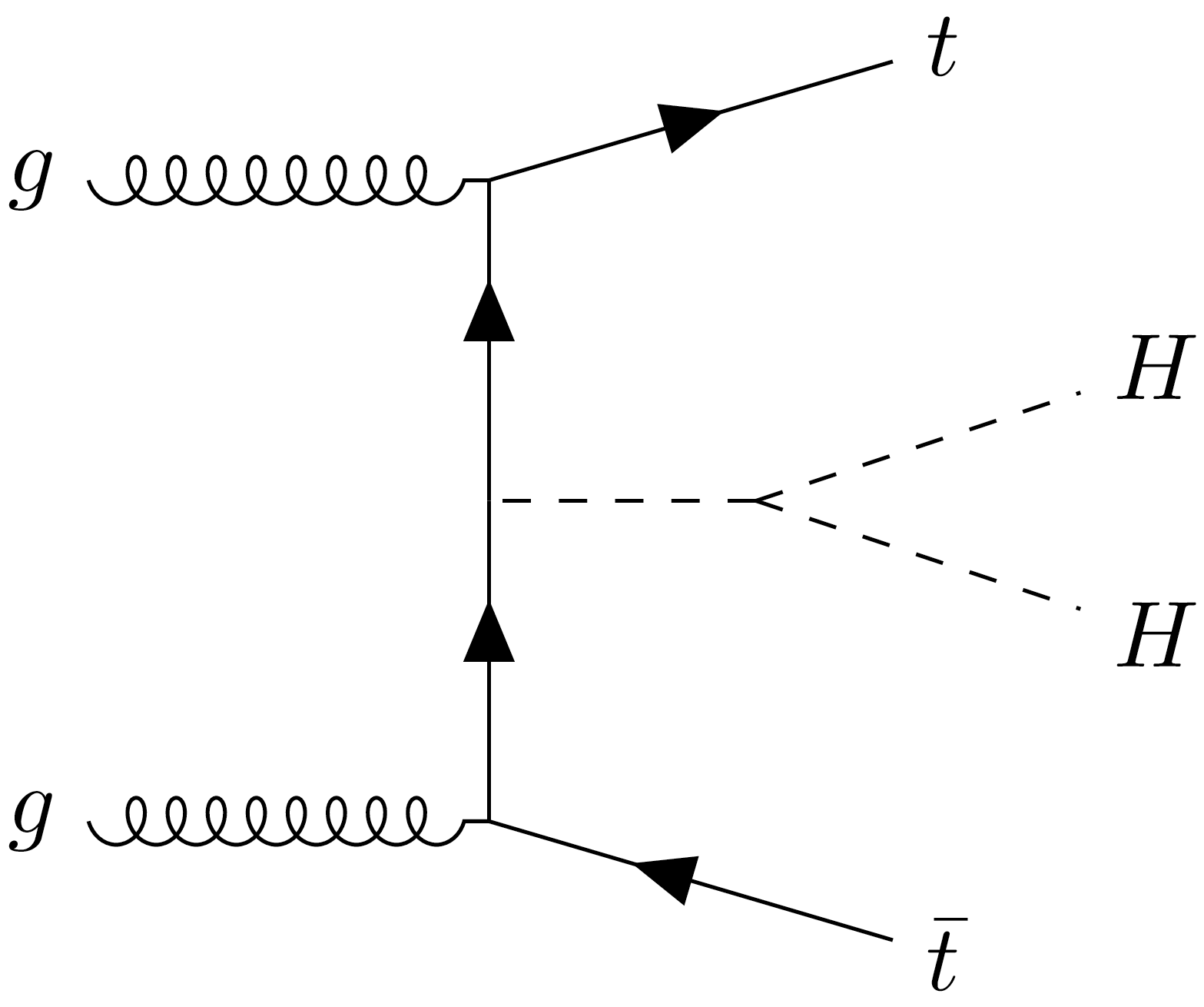
The ATLAS search focused on three ttHH decay signatures: the one-lepton channel (1L), defined by a single lepton (electron or muon) amid a massive "multijet" background; the multi-lepton channel (SSML), targeting a rare phenomenon where events have at least two leptons with the same charge; and the di-photon channel (bbγγ), defined by the two photons created by a Higgs-boson decay. The team used two different machine-learning classifiers to identify signal-like events: an attention-based neural network (transformer model) that learns relationships between many objects in an event was used in the 1L and SSML channels; and boosted decision trees, used in the bbγγ channel.
Even with multiple channels combined and the enormous LHC datasets, fewer than four ttHH events were expected in the selected signal regions, with the largest contribution expected from the 1L channel, followed by SSML and bbγγ.
This first ATLAS search for ttHH production pushes into a new regime where the signal is tiny and the backgrounds vast – demanding precision at every step.
Rare but powerful

All decay channels and signal regions were combined into a statistical fit. The resulting limits on the signal strength (Figure 2), which is the number of observed events divided by the number of expected events, are fully compatible with current theory predictions for all three channels. Remarkably, despite the production rate being nearly 40 times smaller than that of the dominant di-Higgs modes, the upper limit on the signal cross-section is only about a factor of 8 weaker than the ATLAS and CMS combination. Additionally, this is the most sensitive ttHH search to date and the first one targeting 1L and SSML channels.
Why does this matter? A null result can constrain how far Nature might deviate from the Standard Model. The ATLAS team interpreted their data using a framework called Higgs Effective Field Theory (HEFT), which parameterises how undiscovered particles or interactions beyond the direct energy reach of the LHC might subtly alter their measurements. This is described by an “anomalous coupling coefficient” (cttHH, also shown in Figure 1). The new ATLAS result constrained this coefficient to -3.9 < cttHH < 3.3 at a 95% confidence level, so far consistent with the Standard-Model prediction of cttHH=0. This process is sensitive to a different combination of EFT parameters than the leading di-Higgs results, providing a complementary probe of possible new physics effects.
This search pushes the ATLAS Collaboration deeper into unexplored territory of the Higgs sector, advancing knowledge into complex heavy-flavour-rich regimes. As analysis continues on Run-3 data – and with data from HL-LHC on the horizon – expect sensitivity to ttHH production to improve substantially in the years ahead.
Learn more
- Search for Higgs boson pair production in association with top-quark pairs using 196 fb−1 of proton-proton collision data at 13 and 13.6 TeV with the ATLAS detector (arXiv:2603.13113, see figures)
- Combination of ATLAS and CMS searches for Higgs boson pair production at 13 TeV (arXiv:2602.23991, see figures)
- Combination of searches for Higgs boson pair production in proton-proton collisions at 13 TeV with the ATLAS detector (Phys. Rev. Lett. 133 (2024) 101801, arXiv:2406.09971, see figures)
- ATLAS sets record limits on Higgs self-interaction using Run 3 data, Physics Briefing, May 2025