ATLAS records vital low-intensity data during special LHC run
7 May 2026 | By
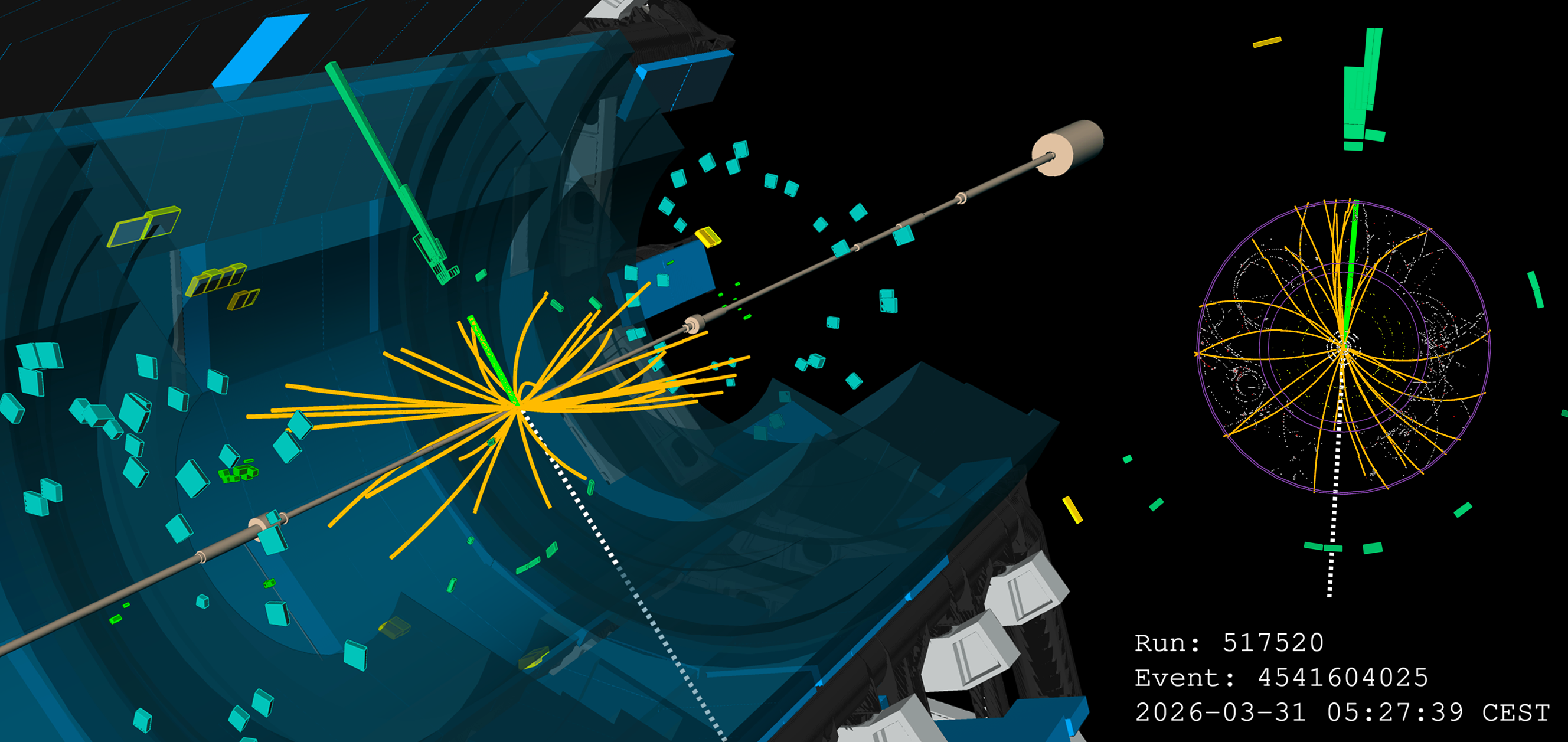
For three weeks in April 2026, the Large Hadron Collider (LHC) did something counterintuitive: it eased off the throttle. Instead of maximising collision rates, the accelerator entered a deliberately quieter operating mode. This shift offered the ATLAS Collaboration a rare opportunity to study fundamental particles in an exceptionally clean experimental environment.
In its usual configuration, the LHC is designed for intensity. Every time the proton beams cross, around 60 interactions take place simultaneously. While this is vital for hunting extremely rare processes, it also creates a dense and noisy environment that can obscure more subtle effects. Last month, the LHC significantly reduced the average number of interactions for a special operation period (a “low-μ run”), providing a unique, invaluable dataset for physicists to explore.
Their top priority is one of the most demanding measurements in particle physics: the mass of the W boson. This particle plays a fundamental role in the Standard Model, acting as a mediator of the weak force. Its mass is closely related to the masses of nature’s heaviest known fundamental particles, the top quark and the Higgs boson. If additional heavy particles exist, the W-boson mass might deviate from the Standard Model prediction, making a precise measurement an essential goal for physicists.


Measuring the W boson is especially challenging because its decay produces a neutrino, which escapes the experiment undetected. Physicists have to indirectly reconstruct the neutrino’s presence by balancing momentum in each event – a task made significantly harder in “noisy” conditions. With a reduced number of overlapping interactions, a low-μ dataset will give physicists a much clearer view of each W-boson decay. While ATLAS researchers have successfully measured the W-boson mass with sub-permille precision (±0.02%), this “quiet” dataset – with over 15 millions W bosons decaying to electron or muon – offers an important opportunity for them to reduce some of the largest remaining uncertainties.
Beyond this flagship measurement, the low-μ run enables several other important goals: studying subtle effects of the strong interaction; performing delicate measurements in flavour physics; and collecting key data for calibrating the detector to improve a whole range of future ATLAS measurements. While the High-Luminosity LHC upgrade will push the accelerator to higher intensity, this successful low-intensity run highlights the flexibility of the LHC and the diverse research approach taken by the ATLAS Collaboration.


Learn more
- CERN Seminar by S. Clawson and B. Gilbert: Nuclear cross sections at the frontier: from cosmic rays to spatially resolved nuclear structure with ATLAS
- Accelerator Report: Excellent performance at the LHC, CERN News, March 2026
- Exploring the Weak Force with ATLAS, ATLAS News, November 2023
- New ATLAS result weighs in on the W boson, ATLAS Physics Briefing, March 2023