ATLAS expands its reach into the high-rate frontier
12 December 2025 | By
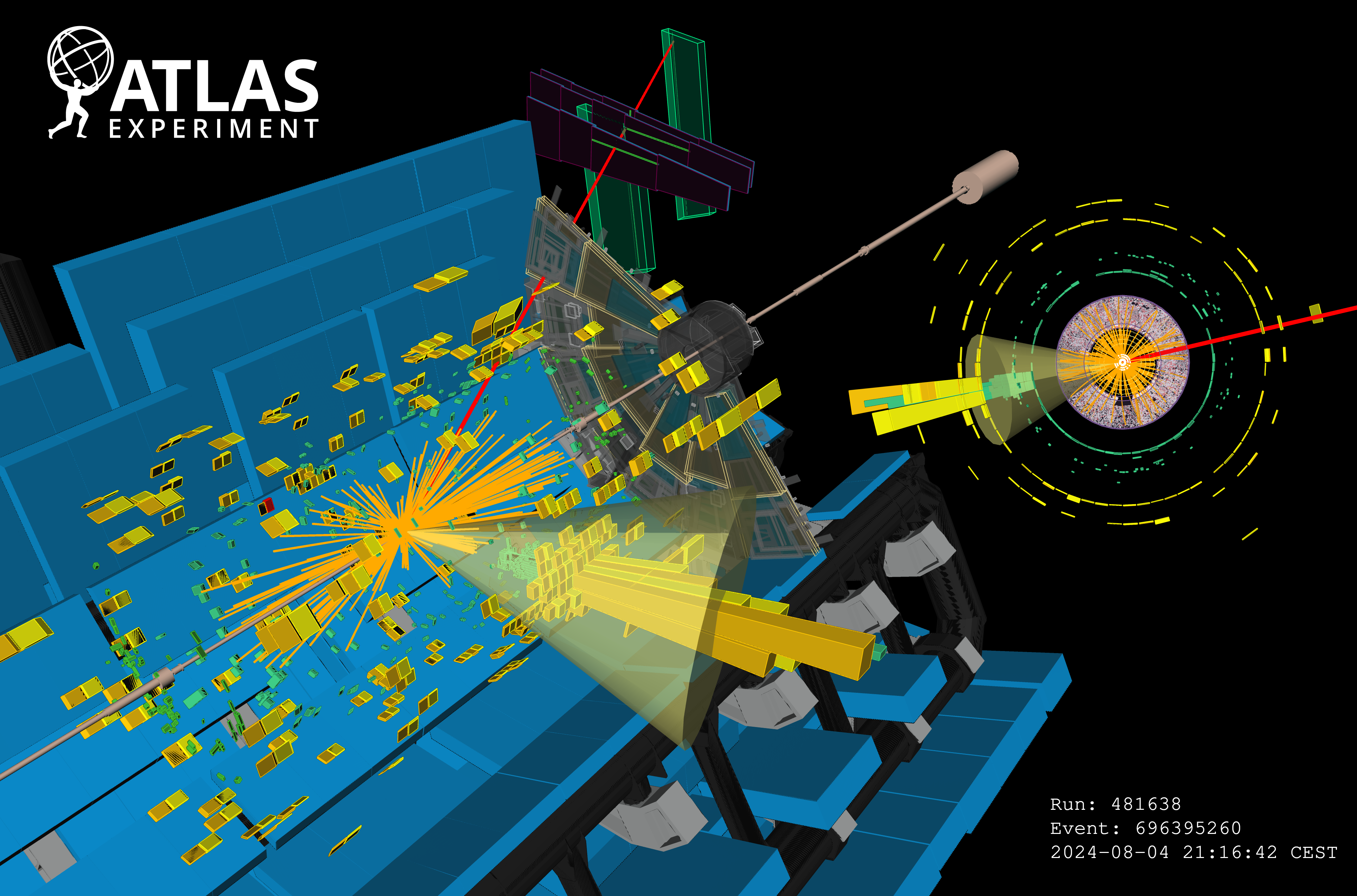
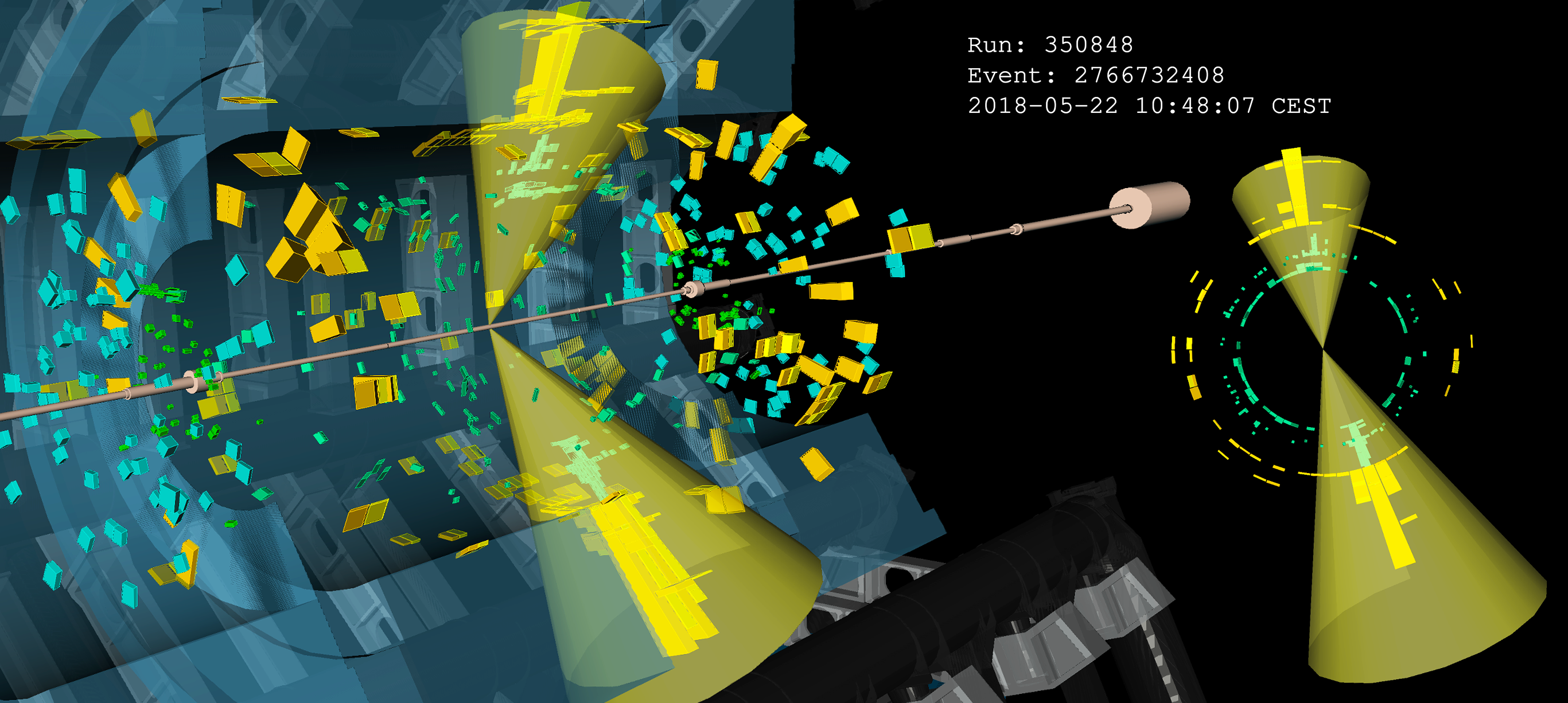
Nature loves symmetry. Nowhere is this more evident than at the Large Hadron Collider (LHC), where the vast majority of proton-proton collisions result in a strikingly symmetrical signature: two concentrated sprays of hadrons (jets) emerging back-to-back with nearly equal momentum. These “dijet” events are a key hunting ground for physics beyond the Standard Model. Thanks to a fundamental feature of particle interactions, almost any new particle that can be produced in a collision of two protons should be able to decay into a pair of gluons or a quark-antiquark pair, leaving the characteristic dijet signature.

Yet the abundance of dijet events presents a challenge. The ATLAS experiment relies on its “trigger” system to select the most interesting of the billion collisions that occur every second. The first-level (L1) trigger, implemented in custom hardware, reduces the LHC’s 40 MHz rate to 100 kHz. Then, the software-based high-level trigger (HLT) used during Run 2 lowers this further to just 1.2 kHz. As a result, the vast majority of dijet events have to be discarded to manage bandwidth constraints.
The ATLAS Collaboration’s innovative trigger-level analysis (TLA) approach provides a way to overcome these limits. Instead of recording the full collision event data, the TLA stream saves only the essential information reconstructed by the HLT, such as jet momenta and variables used for calibration and validation. This reduces the average event size from 1 MB to just 6.5 kB, allowing far more events to be recorded, particularly at low dijet masses (Figure 1). Similar strategies have been used by the CMS Collaboration (e.g. Data Scouting) and the LHCb Collaboration (e.g. Turbo Stream), and in an ATLAS study of a smaller subset of the Run 2 dataset.
ATLAS researchers are delving into an extraordinary dataset – 60 billion trigger-level events collected during LHC Run 2 – to search for new particles.
In a new paper published in Physical Review D, the ATLAS Collaboration presents a search for new particles decaying into dijets, based on 60 billion trigger-level events collected during Run 2 of the LHC (2015-2018). This is more than double the total number of fully reconstructed ATLAS events from LHC Run 1 and 2 combined (25 billion). Using the TLA approach, physicists were able to record data at over 20 times the standard HLT readout rate (up to 27 kHz vs. 1.2 kHz).

Dijet searches look for a small excess in the reconstructed dijet mass spectrum, arising from a potential beyond-the-Standard-Model (BSM) resonance on top of the smoothly falling Standard Model (SM) background. While conventional dijet searches study masses above 1 TeV, this trigger-level analysis extends this sensitivity down to 375 GeV (Figure 2). This is the lowest inclusive dijet mass ever studied at the LHC, without relying on additional constraints on the dijet system (such as initial-state radiation, boosts or b-tagging). The data were found to be compatible with the smoothly falling SM background; the most significant excess is observed for a Z’ signal with a mass of mZ’ = 650 GeV with a global significance of 2.2σ. Following extensive efforts to improve the precision of the background estimate and jet calibration, physicists set world-leading limits on the mass and interaction (“coupling”) strength of new particles in several simplified BSM models.
Looking ahead, trigger-level analyses of Run 3 data promise even greater potential. An upgraded TLA readout stream has allowed ATLAS to record more complex collision event signatures in an even larger dataset, further expanding the experiment’s sensitivity to new physics at the high-rate frontier.
Learn more
- Search for electroweak-scale dijet resonances using trigger-level analysis with the ATLAS detector in 132 fb-1 of proton-proton collisions at 13 TeV (Phys. Rev. D 112 (2025) 092015, arXiv:2509.01219, see figures)
- Search for low-mass dijet resonances using trigger-level jets with the ATLAS detector in proton-proton collisions at 13 TeV (Phys. Rev. Lett. 121 (2018) 081801, arXiv:1804.03496, see figures)
- New data-collection method aids in the hunt for new physics, Physics Briefing, March 2018