ATLAS maps the top quark–Higgs boson interaction with multileptons
6 February 2026 | By
One of the central questions in particle physics is how fundamental particles acquire mass. The top quark, as the heaviest known elementary particle, interacts most strongly with the Higgs boson. As such, it may play a crucial role in understanding how the Higgs field gives rise to particle masses.
The ATLAS Collaboration is studying the production of the Higgs boson together with a top-quark pair (“ttH production”). First observed by the ATLAS and CMS Collaborations in 2018, this process accounts for just 1% of all Higgs-boson production and yet provides a unique opportunity for researchers to directly measure the top–Higgs interaction.
Using the complete LHC Run-2 dataset (collected in 2015–2018), the ATLAS Collaboration has carried out a new measurement of ttH production. The analysis focuses on “multilepton” events, where particle collisions leave several leptons (electrons, muons or taus) in the final state.
Multilepton needles in the haystack

To maximise sensitivity, ATLAS physicists divided their data into six exclusive categories based on the number and charge of the leptons (Figure 1). Categories containing one or two hadronically-decaying tau leptons would be particularly sensitive to Higgs boson decays into taus, while the other categories would focus on Higgs-boson decays into W bosons. All six categories were analysed simultaneously, allowing the small ttH signal to be separated from much more common background processes.
The new ATLAS result improves on the previous Run-2 analysis by combining a larger dataset with enhanced particle identification and reconstruction techniques. Researchers also drew upon more accurate simulations, dedicated studies of the dominant background processes, data-driven methods to constrain background rates, and a refined treatment of experimental uncertainties to bolster their result.
Testing predictions
The ATLAS team assessed how well their measurement matched the Standard Model using the so-called “signal strength”, defined as the observed ttH production rate divided by the predicted rate. The ttH production signal strength (μttH) was measured to be 0.63 +0.20−0.19 While slightly lower than the Standard Model prediction (1.0), the value is compatible within experimental uncertainties. The analysis provides evidence of ttH production in multilepton final states with a statistical significance of 3.3 standard deviations (σ), compared with an expected significance of 5.3σ.
A complementary measurement of Higgs-boson production in association with a single top quark (tH) was also performed. The measured signal strength, μtH = 7.2+4.6−4.0, is slightly above the Standard Model expectation. A similarly high value was reported in previous ATLAS and CMS studies of this process.

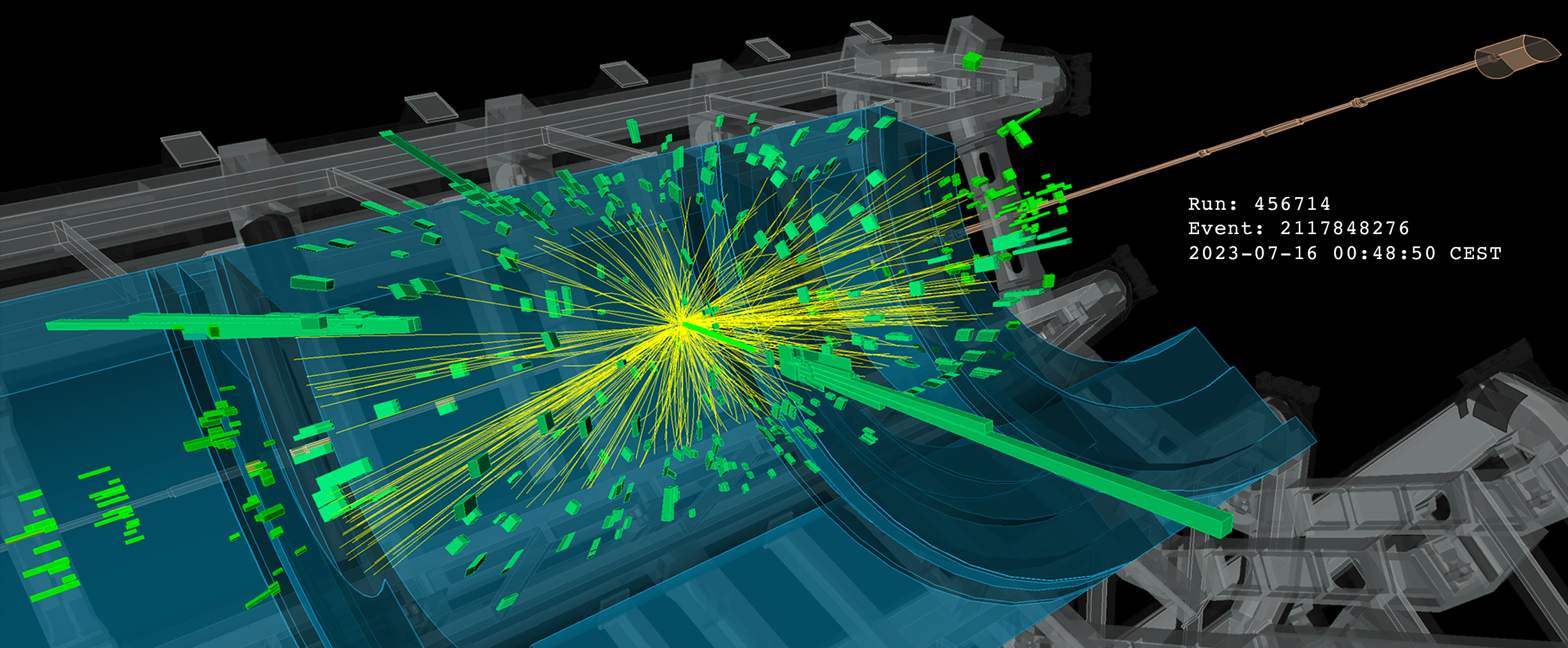
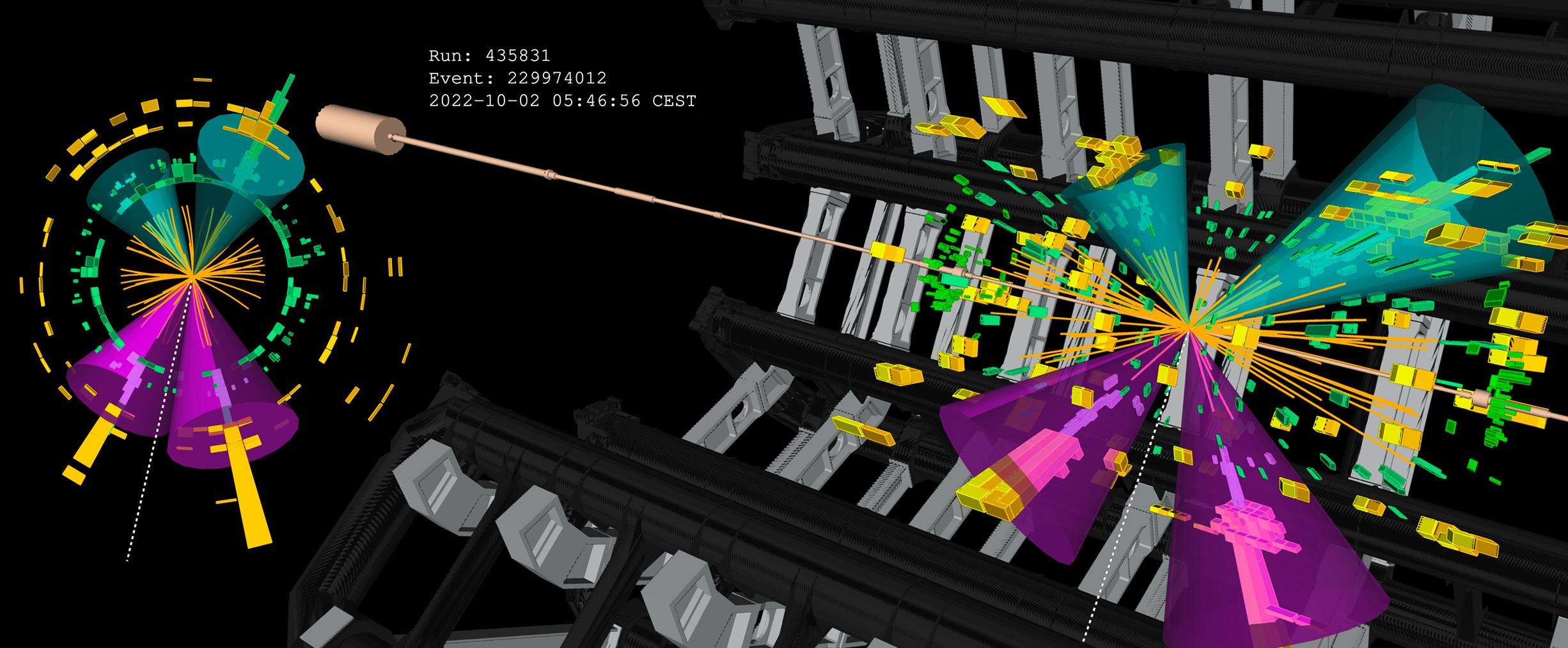
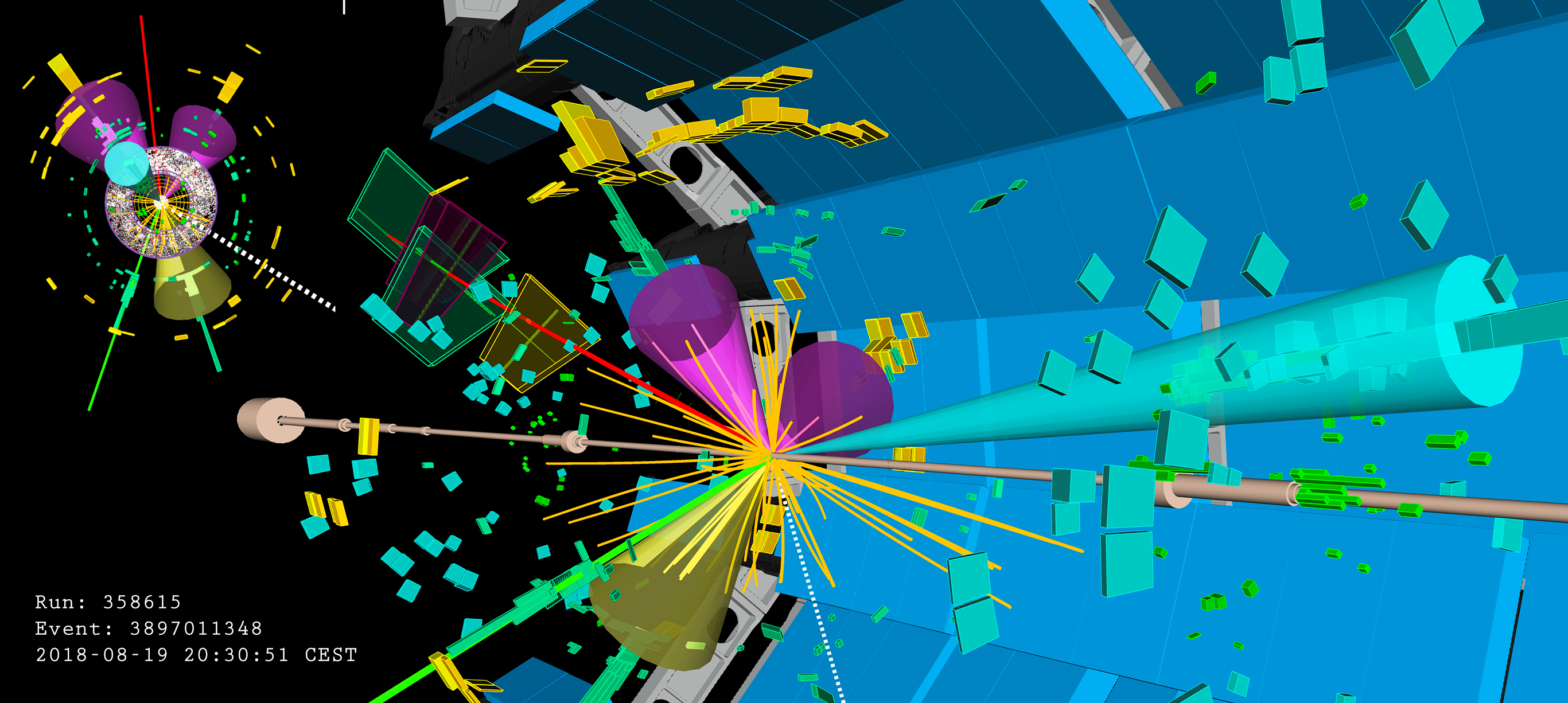
At the ATLAS experiment, scientists are exploring the relationship between the heavyweights of the subatomic world: the top quark and the Higgs boson.
The Higgs boson in motion

Researchers also studied the transverse momentum of the Higgs boson, which can be used to probe different Higgs production mechanisms and possible deviations from the Standard Model interactions. Since the observed leptons can come from either Higgs-boson or top-quark decays and several neutrinos escape detection, the kinematic system cannot be fully reconstructed. Instead, the Higgs boson’s transverse momentum must be inferred statistically using a Graph Neural Network trained on the full event topology of simulated ttH events. Applying a simplified template cross-section (STXS) framework, the ttH production rate was measured in three ranges of transverse momentum (Figure 2).
Testing the "symmetry" of the Higgs boson
Having studied the ttH production rate, physicists turned their attention to more detailed properties of the top-Higgs interaction. The Standard Model predicts that the Higgs boson’s interactions with other particles should have even charge-parity (CP) symmetry. Any evidence of CP-violating interactions (CP-odd) would indicate the presence of as-yet undiscovered phenomena.
In their new analysis, ATLAS researchers tested whether the top–Higgs interaction could contain a mixture of different CP components. The degree of CP mixing is parameterised by the mixing angle α, where α = 0° corresponds to a purely CP-even interaction and α = 90° to a purely CP-odd one. Values of α > 62° were excluded at a 68% confidence level, supporting the Standard Model description of the Higgs boson and remaining consistent with the best ATLAS constraint to date. Constraints were set on possible CP-odd components of the top-Higgs interaction (Figure 3).
As larger datasets from LHC Run 3 and the High-Luminosity LHC are analysed, ATLAS researchers will further refine ttH measurements and sharpen their knowledge of the top–Higgs interaction.
Learn more
- Measurement of the Higgs boson production in association with top quarks in multilepton final states in proton-proton collisions at 13 TeV with the ATLAS detector (arXiv:2510.23755, see figures)
- Evidence for the associated production of the Higgs boson and a top quark pair with the ATLAS detector (Phys. Rev. D 97 (2018) 072003, arXiv:1712.08891, see figures)
- Search for the production of a Higgs boson in association with a single top quark in proton-proton collisions 13 TeV with the ATLAS detector (JHEP 10 (2025) 093, arXiv:2508.14695, see figures)
- CMS Collaboration: Measurement of the Higgs boson production rate in association with top quarks in final states with electrons, muons, and hadronically decaying tau leptons at 13 TeV (Eur. Phys. J. C81 (2021) 378, arXiv:2011.03652)
- Searching for new sources of matter–antimatter symmetry breaking in Higgs boson interaction with top quarks, ATLAS Physics Briefing, April 2020
- New ATLAS result establishes production of Higgs boson in association with top quarks, ATLAS Physics Briefing, June 2018