The curious case of the disappearing track
10 March 2026 | By
They say a good magician never reveals their secrets. If that’s the case, then Nature is an excellent magician indeed! One of its most elusive tricks could be the ability to make particle tracks seemingly vanish inside the ATLAS experiment. Hunting for this disappearing act could reveal new physics phenomena that lie beyond the Standard Model.
In a new result analysing the full LHC Run-2 dataset (collected 2015-2018), the ATLAS Collaboration studied a unique experimental signature known as "disappearing tracks". This subtle trail could be left by a heavy, long-lived charged particle that travels a very short distance in the innermost layers of the ATLAS experiment before decaying into undetectable particles. Supersymmetry (SUSY) models predict just such a particle, called a chargino, which decays into a very low-energy pion and an invisible neutralino, a candidate for dark matter. Since low-energy pions follow highly curved trajectories in the inner detector, they are extremely difficult to identify in a busy proton-proton collision – causing the chargino’s track to "disappear".


The ATLAS Collaboration has now set the most stringent limits to date on the masses and lifetimes of charginos.

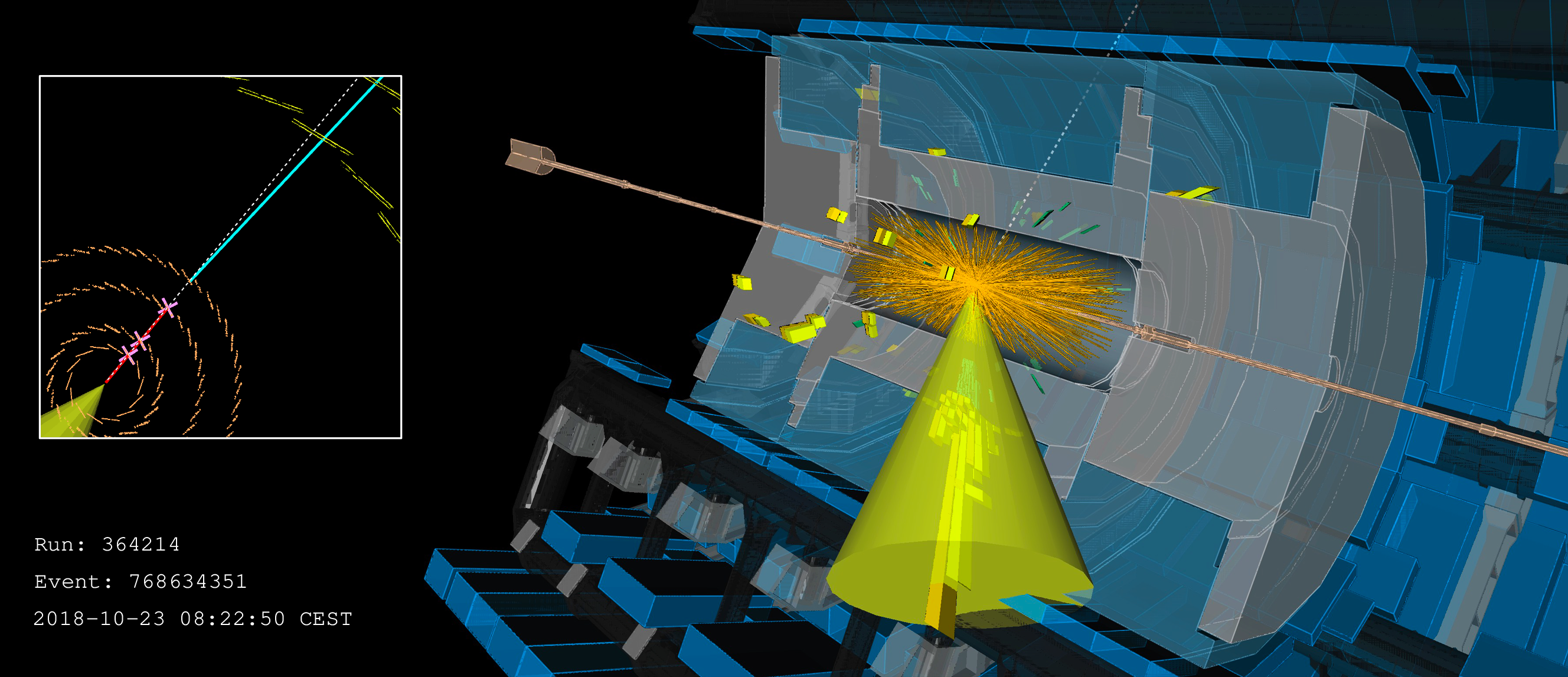
To reveal the chargino's magic trick, physicists first set out to reconstruct the short track left by the chargino before it decays. Standard ATLAS tracking techniques require at least seven “hits” in the silicon layers of the inner detector to reconstruct a particle’s track. For this analysis, physicists deployed a new algorithm capable of identifying tracks from just three or four hits (see event display). This enabled the team to investigate shorter chargino lifetimes than in previous analyses. The ATLAS team then used machine-learning techniques to identify the very low-energy (“soft”) pions produced by the chargino’s decay, with momenta of only 200 MeV – revealing the “disappeared” track! The reconstruction capabilities of both the short track algorithm and the soft-pion reconstruction technique are shown in Figure 1.
No events consistent with chargino production and decay were observed, despite a small excess of events over the expected background. The result extends the sensitivity to charginos into the low-mass region, where the mass difference between charginos and neutralinos is primarily determined by quantum loop effects from Standard Model particles. As shown in Figure 2, the ATLAS Collaboration has now set the most stringent exclusion limits to date on the masses and lifetimes of charginos: up to 225GeV for charginos with lifetimes below 0.03ns and up to 720GeV for a lifetime of 1ns.
The novel techniques deployed in this search will be built upon in the coming years, as researchers continue the search for disappearing charginos using the full LHC Run-3 dataset (2022–ongoing). The next act awaits!
Learn more
- CERN LHC Seminar presentation by J. Shahinian: Closing the gap in compressed SUSY searches at ATLAS
- Search for long-lived charginos and tau-sleptons using final states with a disappearing track in proton-proton collisions at 13 TeV with the ATLAS detector (arXiv:2603.08315, see figures)
- Search for long-lived charginos based on a disappearing-track signature in proton-proton collisions at 13 TeV with the ATLAS detector (JHEP 06 (2018) 022, arXiv:1712.02118, see figures)
- Quest for the lost arc, ATLAS Physics Briefing, March 2017
- CMS Collaboration: A disappearing act in CMS, CMS Briefing, 2020