ATLAS deepens the search for long-lived particles with Run 3 data
4 August 2026 | By
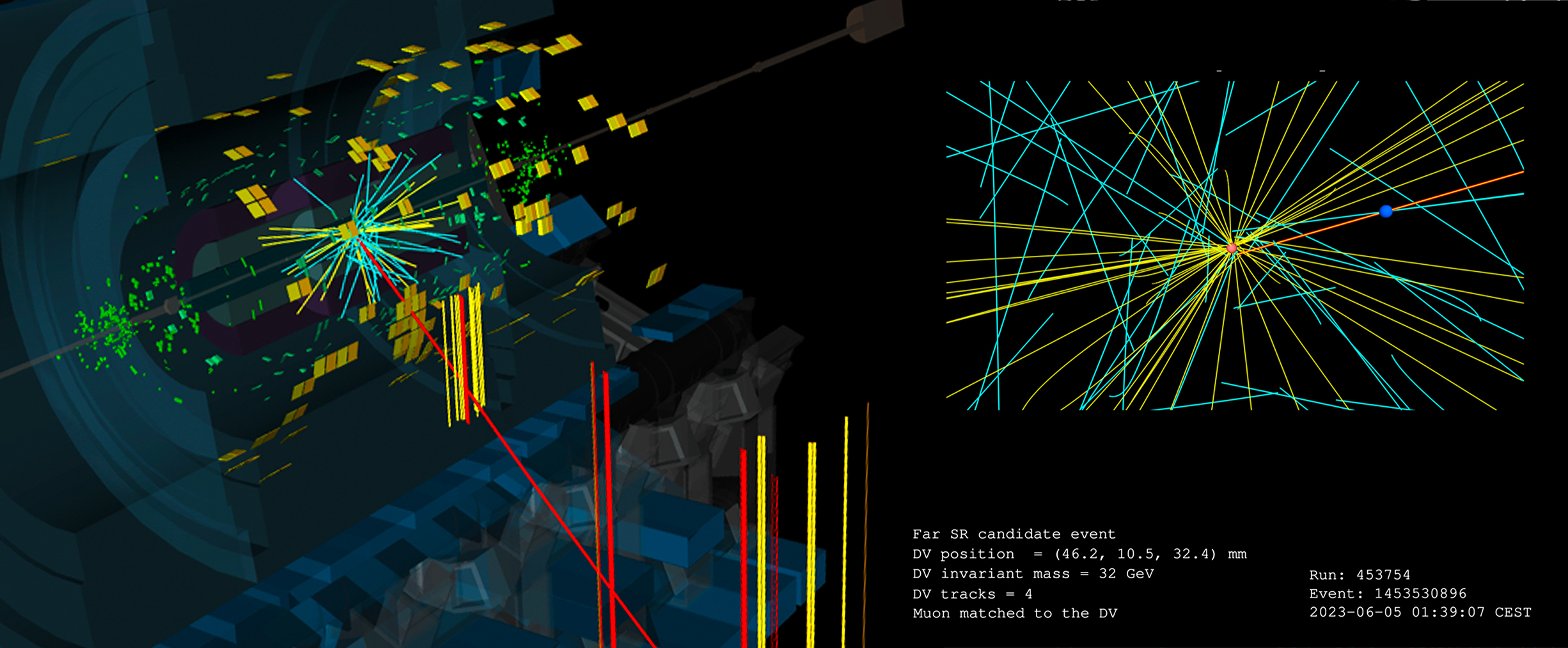
Long-lived particles (LLPs) are among the most compelling targets in the search for physics beyond the Standard Model. Unlike most particles produced in proton–proton collisions at the Large Hadron Collider (LHC), which decay almost instantaneously, LLPs can travel a measurable distance before decaying. This delay can leave a striking signature in the ATLAS experiment: “displaced” tracks away from the interaction point (see event display). While the Standard Model contains a few LLPs – bb-hadrons, for example, travel measurable distances before decaying and muons travel through the entire ATLAS detector before decaying – many theories extending the Standard Model predict additional LLPs. These new particles could help explain outstanding mysteries in physics, such as the nature of dark matter.

To search for these hypothetical particles, researchers typically look for the experimental signatures left behind when an LLP decays, which often occur at some distance from the interaction point. When several displaced tracks originate from the same location, they can be reconstructed as a displaced vertex. In addition, some LLP models predict decays that produce displaced muons. The ATLAS Collaboration has released a new search for massive, long-lived particles at a collision energy of 13.6 TeV, targeting events containing at least one displaced vertex and one displaced muon. This is the first ATLAS search for LLPs to use LHC Run-3 data collected between 2022 and 2024, corresponding to an integrated luminosity of 164 fb-1.
The analysis benefits from several important improvements in tracking, vertex reconstruction and real-time event-selection tools (“triggers”). In 2022, the ATLAS Collaboration introduced a dedicated trigger for displaced muons, capable of identifying muons with transverse momentum as low as 20 GeV, thus extending the experiment's sensitivity to LLPs with masses at the electroweak scale. Improvements in displaced tracking and vertex reconstruction further enhanced sensitivity to LLPs with mean decay lengths ranging from one millimetre – comparable to the typical decay length of a b-hadron – to tens of centimetres, covering a wide range of possible new-physics scenarios.
Leveraging Run-3 ATLAS detector capabilities, the ATLAS Collaboration has set competitive model-independent limits on events with a displaced vertex and displaced muon, and world-leading limits on multiple benchmark models of R-parity-violating supersymmetry.

To estimate the number of background events that could mimic the LLP signal, researchers developed a fully data-driven approach that accounted for unconventional sources, including cosmic rays, fake tracks (i.e. tracks reconstructed from unrelated hits that do not correspond to a real particle) and decays of b-hadrons. Their method used discriminating variables such as muon displacement and displaced-vertex mass to distinguish these backgrounds from the signal directly in collision data, as simulations do not accurately model these processes.
No significant excess above the expected background was observed (see Figure 1) and the results were interpreted in two complementary ways. In a model-independent approach, researchers set limits as low as 0.018 fb on the visible cross-section of events containing at least one displaced vertex and one displaced muon. In a model-dependent approach, the team set world-leading limits on several benchmark models of R-parity-violating supersymmetry (see Figure 2), improving previous limits on the production cross section by up to two orders of magnitude for some benchmark scenarios.
Future analyses will continue to explore displaced signatures using the full Run 2 and Run 3 datasets, further developing these techniques to enhance sensitivity to LLPs at the High-Luminosity LHC and beyond.
Learn more
- Search for massive, long-lived particles with displaced vertices and displaced muons in proton-proton collisions at 13.6 TeV with the ATLAS experiment (Phys. Lett B 878 (2026) 140509, arXiv:2603.01991, see figures)
- ICHEP 2026 presentation by Cristiano Sebastiani: ATLAS searches with unconventional signatures and analysis workflows
- LLP 2026 presentation by Laura Bruce: Search for massive, long-lived particles with displaced vertices and displaced muons using ATLAS 2022-2024 Data
- La Thuile 2026 presentation by Emily Duden: Search for massive, long-lived particles in events with displaced vertices and displaced muons at 13.6 TeV with the ATLAS experiment