Polarised bosons: a window into the Higgs mechanism
4 August 2026 | By
While the Higgs mechanism is best known for breaking electroweak symmetry and giving fundamental particles mass, it can also leave a distinctive imprint on the polarisation of certain particles. A massless particle such as the photon only has two transverse polarisation states. By contrast, the massive W and Z bosons – the carriers of the weak force – have an additional longitudinal polarisation state, in which their spin is oriented perpendicular to their direction of motion. The existence of this extra state is a direct consequence of the Higgs mechanism. Measuring how often W and Z bosons are produced in different polarisation states thus offers a unique window into this fundamental process.
Polarisation studies of W and Z bosons began at the Large Electron–Positron (LEP) collider experiments, the predecessor of the Large Hadron Collider (LHC). Taking full advantage of the LHC dataset and novel analysis techniques, the ATLAS Collaboration pioneered measurements of polarised boson scattering and observed the joint polarisation of W and Z bosons. Now, with yet more data and refined methods, physicists are tackling even rarer processes. Such measurements would either provide support for the Higgs mechanism or hint new physics beyond the Standard Model.
In new results presented at a CERN seminar, the ATLAS Collaboration reported the first observation of ZZ events containing two longitudinally polarised Z bosons, together with evidence for longitudinally polarised Z bosons in electroweak WZ production accompanied by two particle jets – a process that is particularly sensitive to boson scattering.
Observing two longitudinally polarised Z bosons

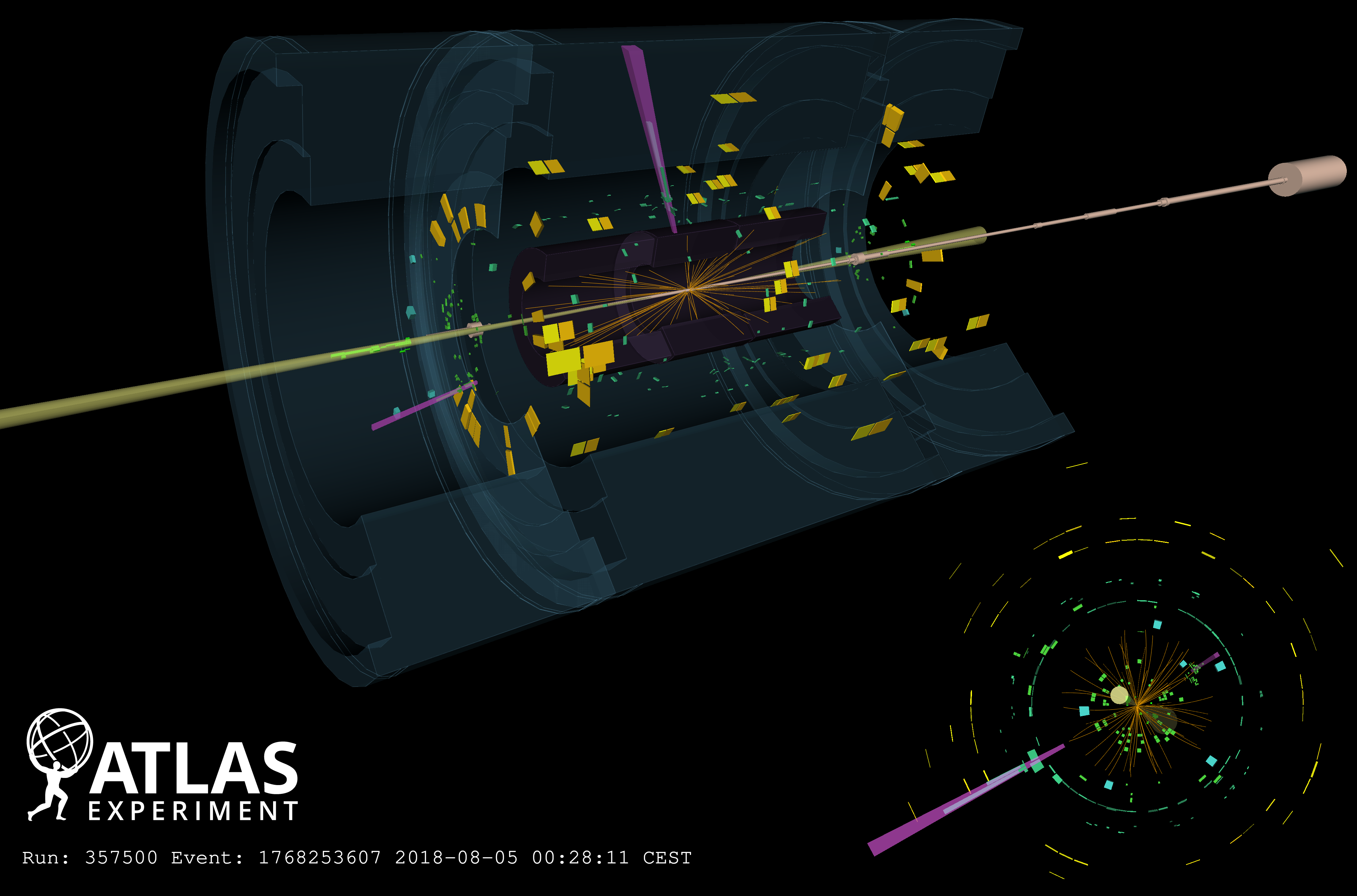
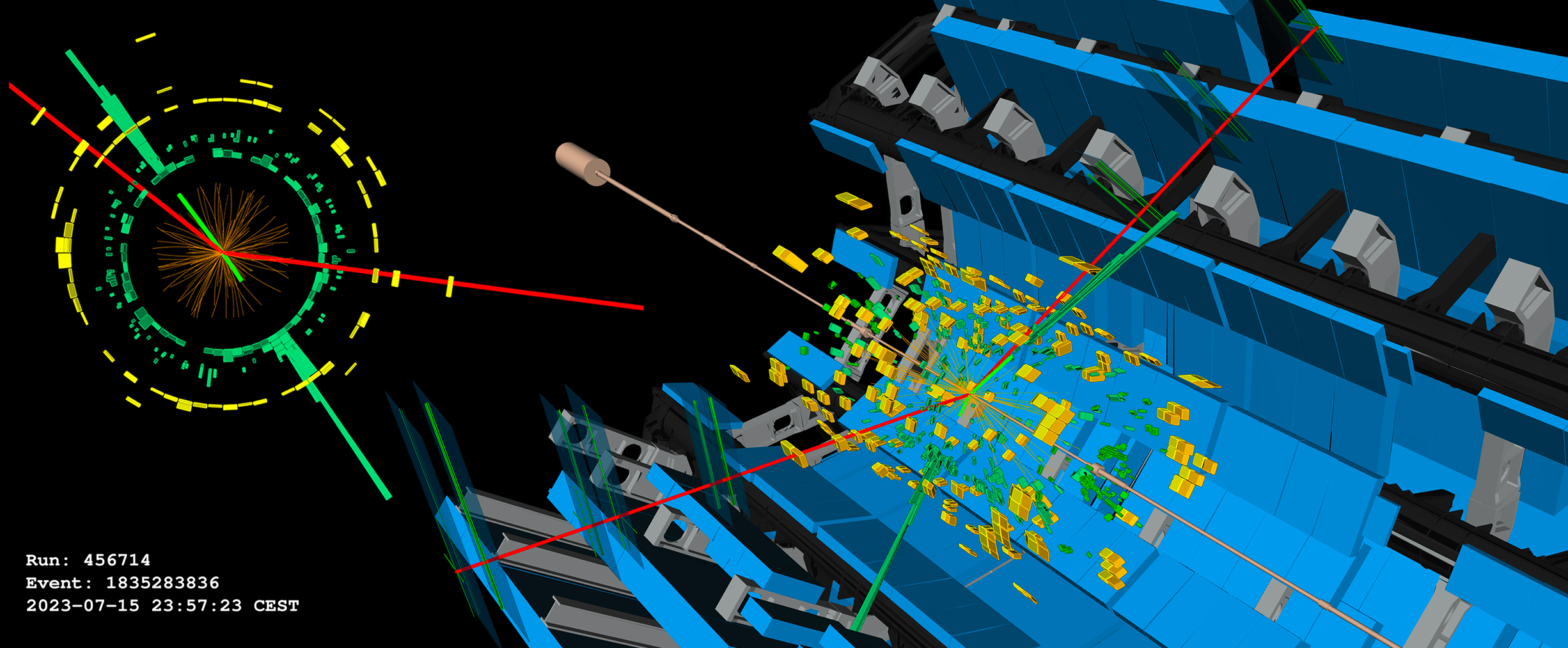
Among the rare diboson processes, the simultaneous production of two longitudinally polarised Z bosons is one of the rarest. It is also one of the cleanest to study experimentally. Z bosons can decay into pairs of charged leptons (electrons or muons), whose decay kinematics can be fully reconstructed in the ATLAS experiment. The ATLAS Collaboration analysed 164 fb⁻¹ of proton–proton collision data collected at a centre-of-mass energy of 13.6 TeV between 2022 and 2024, selecting events where the Z bosons decay into two pairs of oppositely charged electrons or muons.
The angular distributions of these leptons retain information about the polarisation of their parent bosons. To maximise sensitivity, researchers trained a multivariate classifier using these angular observables to distinguish events containing two longitudinally polarised Z bosons from those with other polarisation combinations. They then combined the Run-3 analysis with the corresponding Run-2 measurement to achieve the first observation of the simultaneous production of two longitudinally polarised Z bosons, with an observed (expected) significance of 6.5 (5.6) standard deviations (Figure 1).
The team also measured the Z boson polarisation fractions both for the full dataset and in different ranges of the four-lepton invariant mass. Since the Standard Model predicts such events become increasingly rare at higher energies, these measurements provide an important test of the theory. The measured results agree well with Standard-Model predictions.
Taking full advantage of the LHC dataset and novel analysis techniques, the ATLAS Collaboration are tackling extremely rare measurements of polarised bosons. Such studies would either provide support for the Higgs mechanism or hint new physics beyond the Standard Model.
Longitudinal polarisation in boson scattering

Longitudinally polarised bosons also offer a powerful way to test the Standard Model. When two such bosons scatter, they can exchange a Higgs boson. Without this contribution – or if the Higgs boson behaved differently from Standard Model predictions – the scattering rate would grow uncontrollably with energy, leading to a “resonance catastrophe”. Measuring the fraction of longitudinally polarised bosons provides a sensitive test of this mechanism.
For the first time, the ATLAS Collaboration measured the boson polarisation fractions in electroweak production of a W and Z boson in association with two jets (electroweak WZjj production). This rare Standard Model process contains events where two quarks radiate weak bosons that subsequently scatter from one another. The analysis uses the full Run-2 dataset (recorded between 2015 and 2018) and Run-3 data collected from 2022 to 2024. As in the ZZ analysis, only decays of the W and Z bosons into electrons and muons were considered.
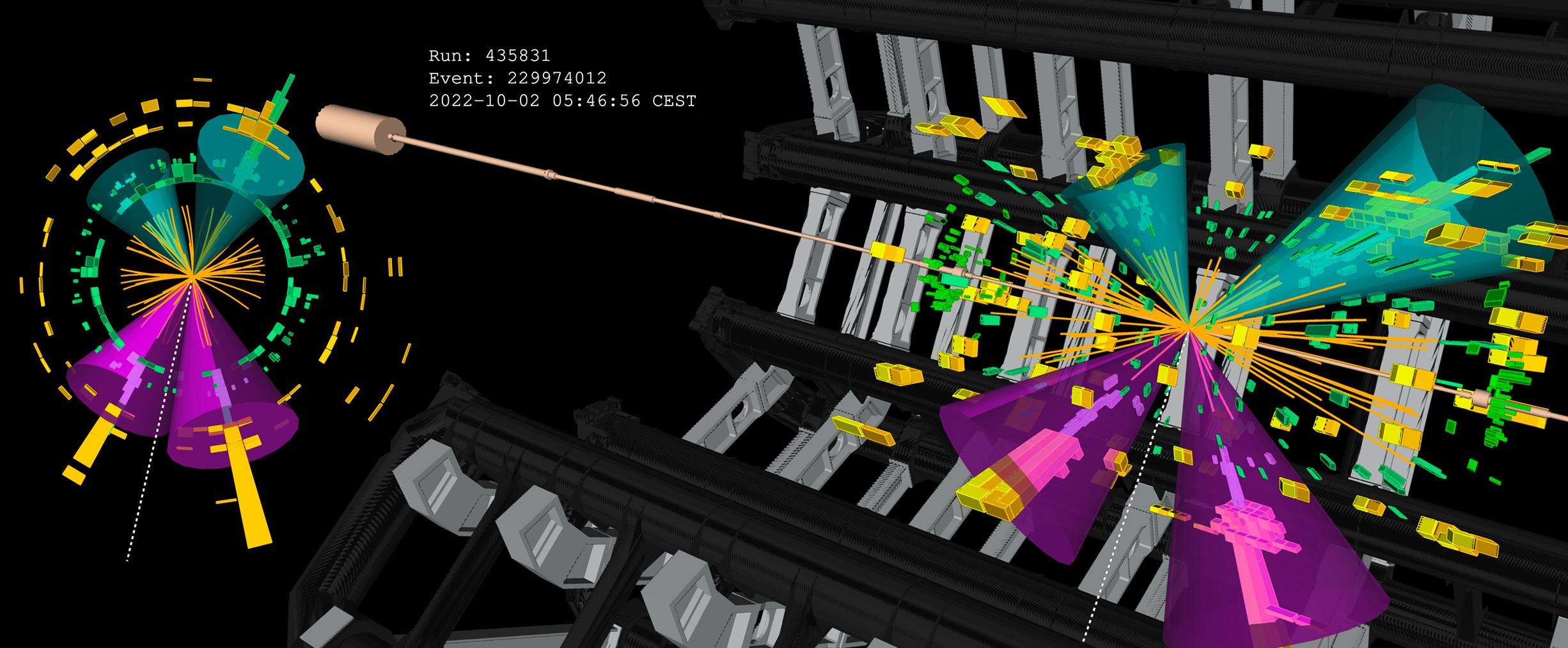
This measurement was particularly challenging due to significant backgrounds from other processes, especially WZjj production via the strong interaction. In the signal region, only about 13% of selected events are expected to originate from electroweak WZjj production. Out of the total 1860 predicted events containing signal and background events, approximately 65 are expected to be electroweak WZjj events, which contain at least one longitudinally polarised W or Z boson, and just 20 are expected to contain two. Researchers employed advanced machine-learning techniques to isolate the tiny signal and identify the different boson polarisation states. A statistical fit extracted the overall electroweak WZjj production rate and the fractions of events containing one or two longitudinally polarised bosons. The measurements were compared with state-of-the-art theoretical predictions developed in close collaboration with theorists.
The ATLAS Collaboration found evidence for longitudinally polarised Z bosons with an observed (expected) significance of 4.0 (2.9) standard deviations, corresponding to an observed (expected) longitudinal Z polarisation fraction of 32% ± 9% (27.45% ± 0.08%). The measured electroweak WZjj cross section agrees with predictions. No evidence was found for longitudinally polarised W bosons, regardless of the Z boson polarisation. The team set upper limits on these fractions. All measurements remain consistent with Standard-Model predictions within 2.4 standard deviations (see Figure 2).
With the much larger datasets expected from the High-Luminosity LHC, physicists will be able to measure these rare polarisation states with new precision – providing increasingly sensitive tests of the Higgs mechanism and new opportunities to uncover physics beyond the Standard Model.
Learn more
- Observation of pair production of longitudinally polarized Z bosons in four-lepton final state with the ATLAS detector (arXiv:2607.12879, see figures)
- Evidence for longitudinally polarised Z bosons in electroweak WZ production in association with two jets from pp collisions at 13 TeV and 13.6 TeV with the ATLAS detector (STDM-2024-03)
- CERN Seminar presentation by L. Xu: No Time to Be Transverse: Probing Electroweak Symmetry Breaking with Longitudinal Weak Bosons at ATLAS