ATLAS publishes first paper on Public Engagement with Science
2 September 2026 | By
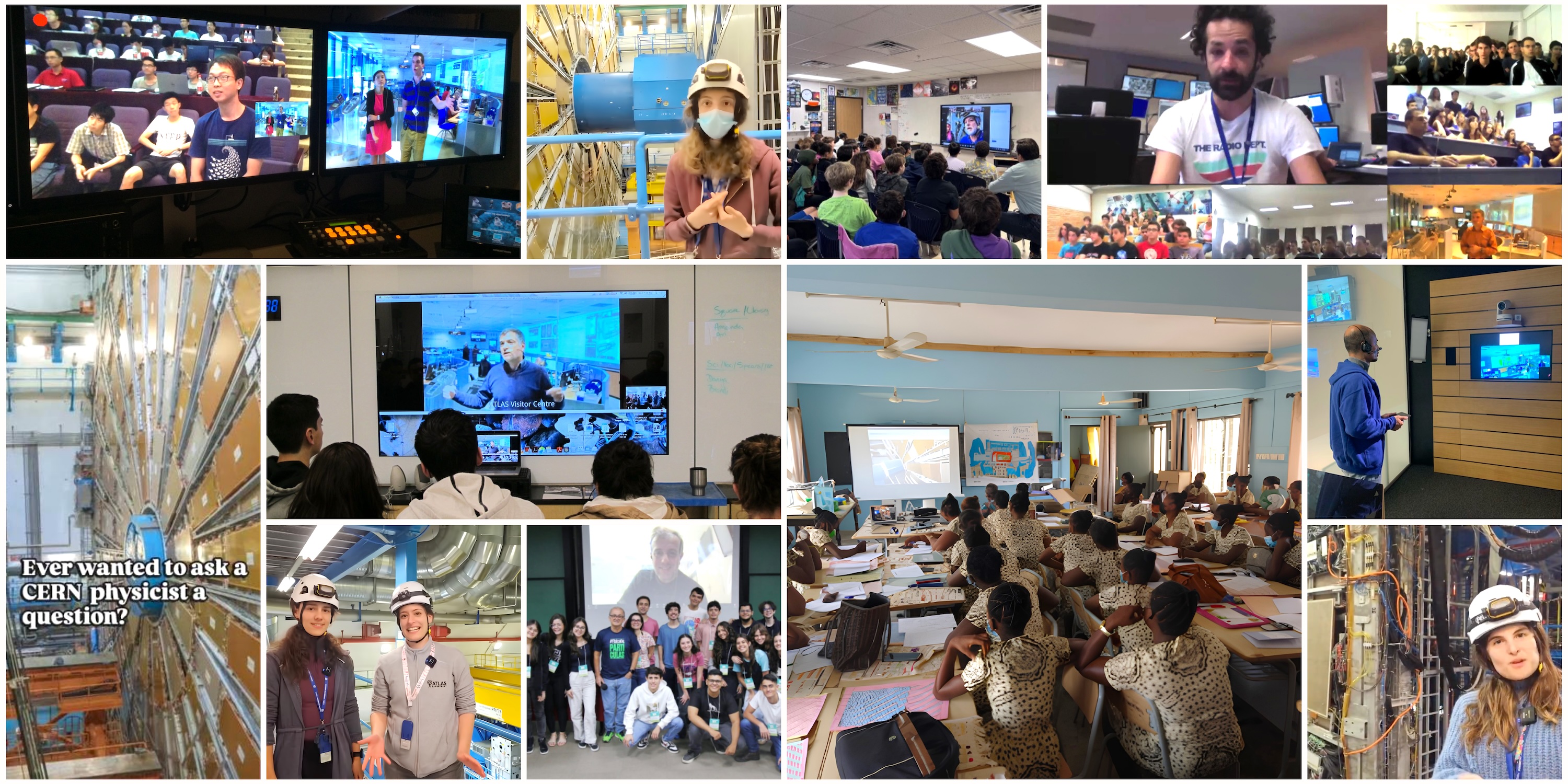
You can’t exactly take the ATLAS experiment on tour. At 7,000 tonnes and buried 100 metres underground at CERN, it’s not easy to move. So, for more than a decade, the ATLAS Collaboration has found another way to bring the experiment to people around the world: live, interactive virtual visits with the scientists who work on it.
In a recent paper published in the European Physical Journal Plus, the ATLAS Collaboration documents the evolution and impact of its flagship Virtual Visits programme. The paper is the Collaboration’s first publication focused specifically on science education, communication and outreach. It traces the programme from its beginnings as an experimental outreach effort in 2010 through its growth into a global programme – connecting classrooms in the Amazon, schools in the Himalayas and even a research station in Antarctica. Drawing on data collected between 2019 and 2025, the paper examines the programme’s reach and impact.
Global reach, local connection

The core mission of the ATLAS Virtual Visit programme is to connect audiences worldwide with particle physicists and engage them in accessible discussions about cutting-edge research. While visiting CERN in person is an unforgettable experience, financial and logistical barriers can make such a trip difficult for many students and public groups. Video conferencing has allowed the Collaboration to break down these barriers: between 2019 and 2025, the Collaboration hosted 698 virtual visits, engaging tens of thousands of participants across nearly 70 countries (see Figure 1).
Interactivity is central to the programme. Far from simple one-way broadcasts, Virtual Visit audience members are encouraged to engage in conversation with the scientist(s) hosting the visit. Most hosts are volunteers from the ATLAS Collaboration, who bring their diverse scientific expertise, language skills and cultural backgrounds to each visit. Where possible, audiences are paired with volunteer scientists who share their native language and cultural background, making it easier to engage, ask questions and connect with the hosts. Between 2019 and 2025, Virtual Visits were held in 19 different languages.
The core mission of the ATLAS Virtual Visit programme is to connect audiences worldwide with particle physicists and engage them in accessible discussions about cutting-edge research.
Constant evolution

The ATLAS Virtual Visit programme has continuously evolved to enhance the visitor experience. Early sessions were hosted directly from the ATLAS Control Room before transitioning in 2014 to a dedicated space in the ATLAS Visitor Centre, equipped with modern videoconferencing technology. In 2019, the ATLAS Collaboration expanded the programme’s reach, introducing live Virtual Visits from the experimental cavern during year-end maintenance stops and long LHC shutdowns. These exclusive sessions take participants beyond the ATLAS visitor platform, offering real-time, up-close views of the towering detector.
When the COVID-19 pandemic disrupted in-person gatherings worldwide, demand for virtual engagement surged. The ATLAS Collaboration adapted rapidly by introducing Open Virtual Visits streamed via Zoom and YouTube, allowing individual science enthusiasts and families to join live guided tours. Figure 2 shows that the programme reached a peak of 155 visits in 2021 and has since maintained around 100 visits per year, demonstrating sustained engagement beyond the pandemic-driven increase.
More than just a tour
Beyond participation numbers, the paper highlights the positive impact on participants and educators. Teachers report successfully integrating Virtual Visits into their physics curricula, sparking sustained curiosity and in many cases inspiring students to pursue STEM studies and careers. Feedback received also highlighted how the direct dialogue with ATLAS scientists has given students an authentic and personal perspective on particle physics, helping them connect what they learn in the classroom with the people behind ATLAS research.
Looking ahead, the programme will continue to evolve with new technologies and communication platforms. The goal is simple: to give even more audiences the opportunity to engage directly with particle physics and make fundamental science open to all.
Learn more
- Breaking barriers: the impact of ATLAS Virtual Visits in science communication (Eur. Phys. J. Plus 141, 874 (2026), arXiv:2601.22457, see figures)
- ATLAS Virtual Visit Dashboard
- Register your group for an ATLAS Virtual Visit or join the upcoming open Virtual Visit (for individuals, to be held 24 September 2026).