ATLAS spots rare high-energy Higgs bosons for the first time
31 March 2026 | By
The ATLAS Collaboration reports the first evidence of Higgs-boson production at high transverse momentum in decays to a pair of bottom quarks.
Almost 15 years since its discovery by the ATLAS and CMS Collaborations, the Higgs boson has become a powerful tool in the search for new phenomena beyond the Standard Model. Among the many avenues of exploration, the study of Higgs bosons produced at very large transverse momentum is particularly promising. New physics phenomena can have a strong impact on this production rate, making it a sensitive avenue of exploration, complementary to “precision” measurements of Higgs-boson properties. In this regime, the production rate becomes sensitive to the quantum structure of Higgs-boson interactions – a possibility first proposed by theorists as early as 1988, before the LHC was even being designed.
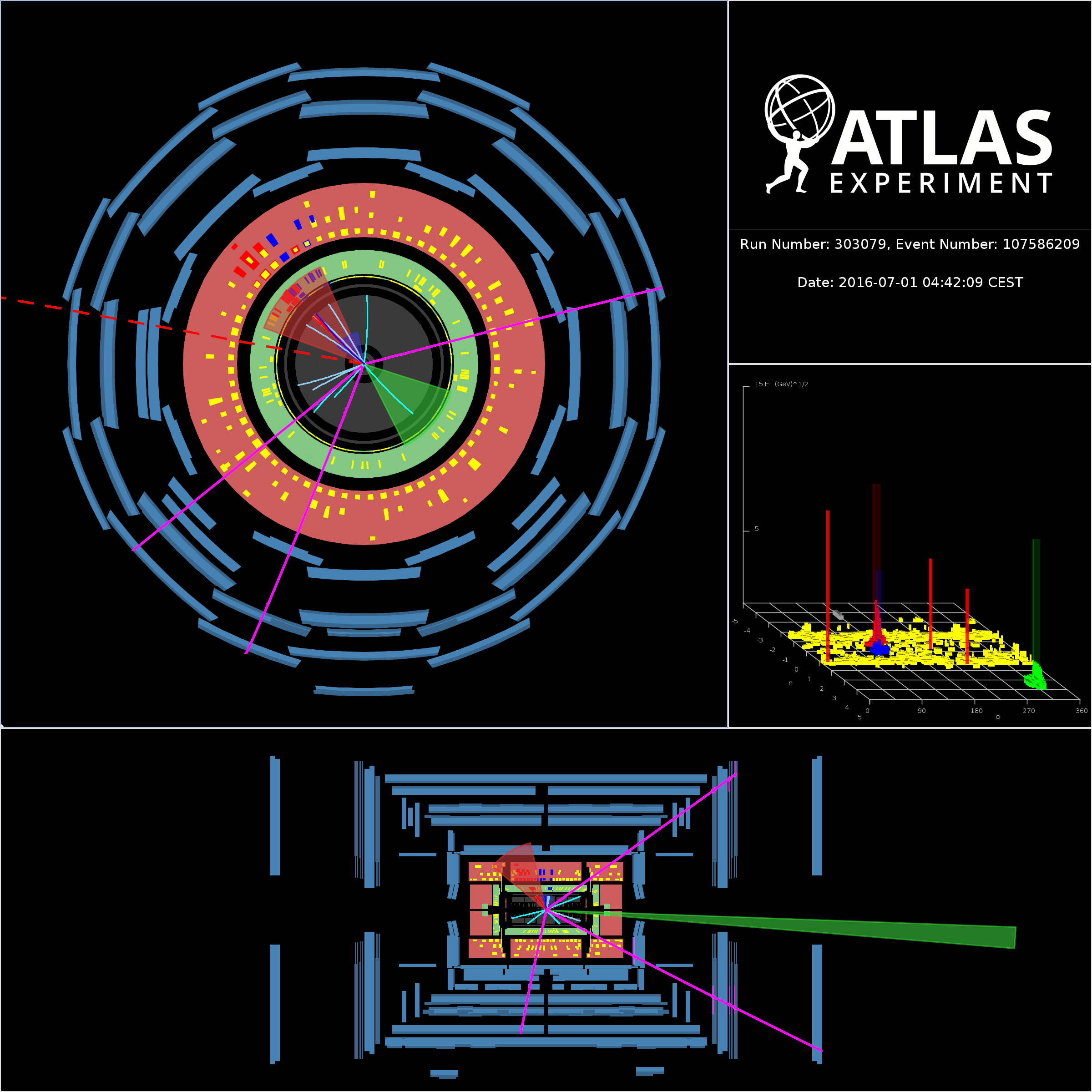
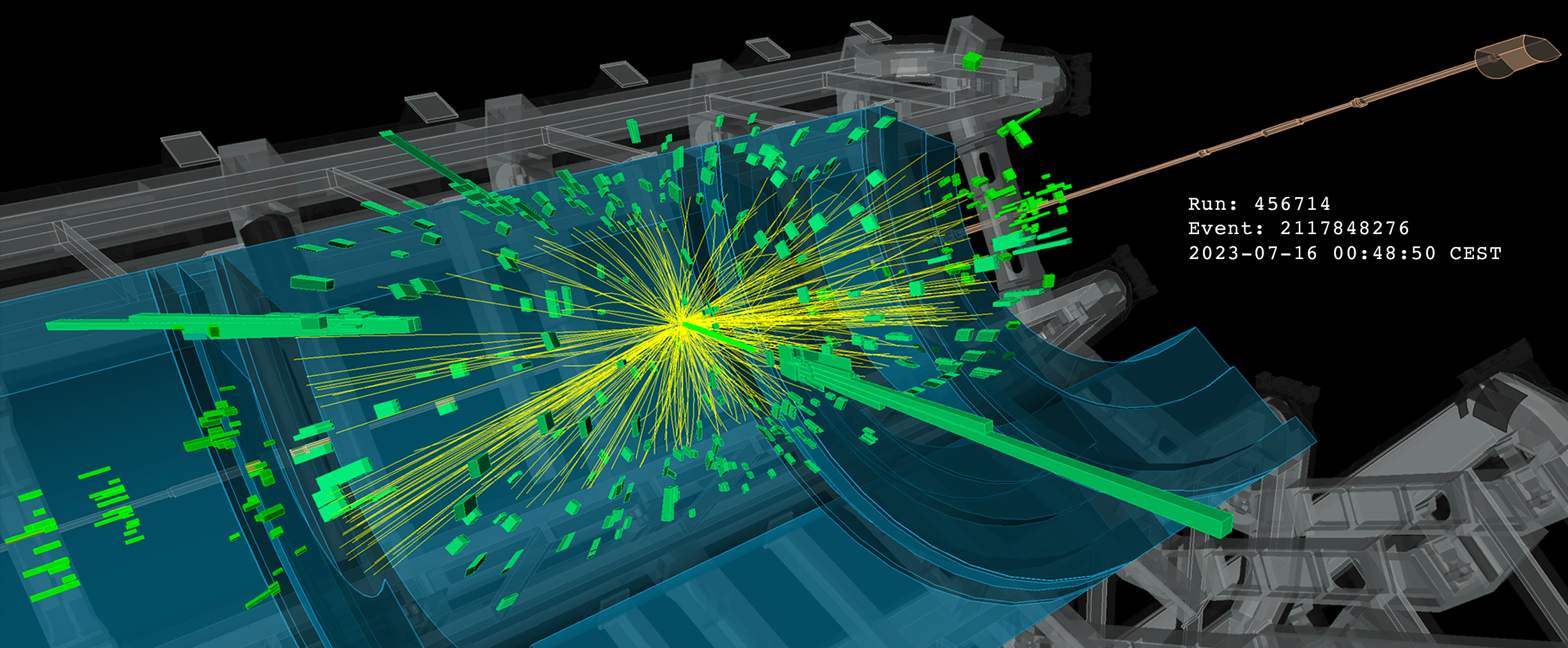
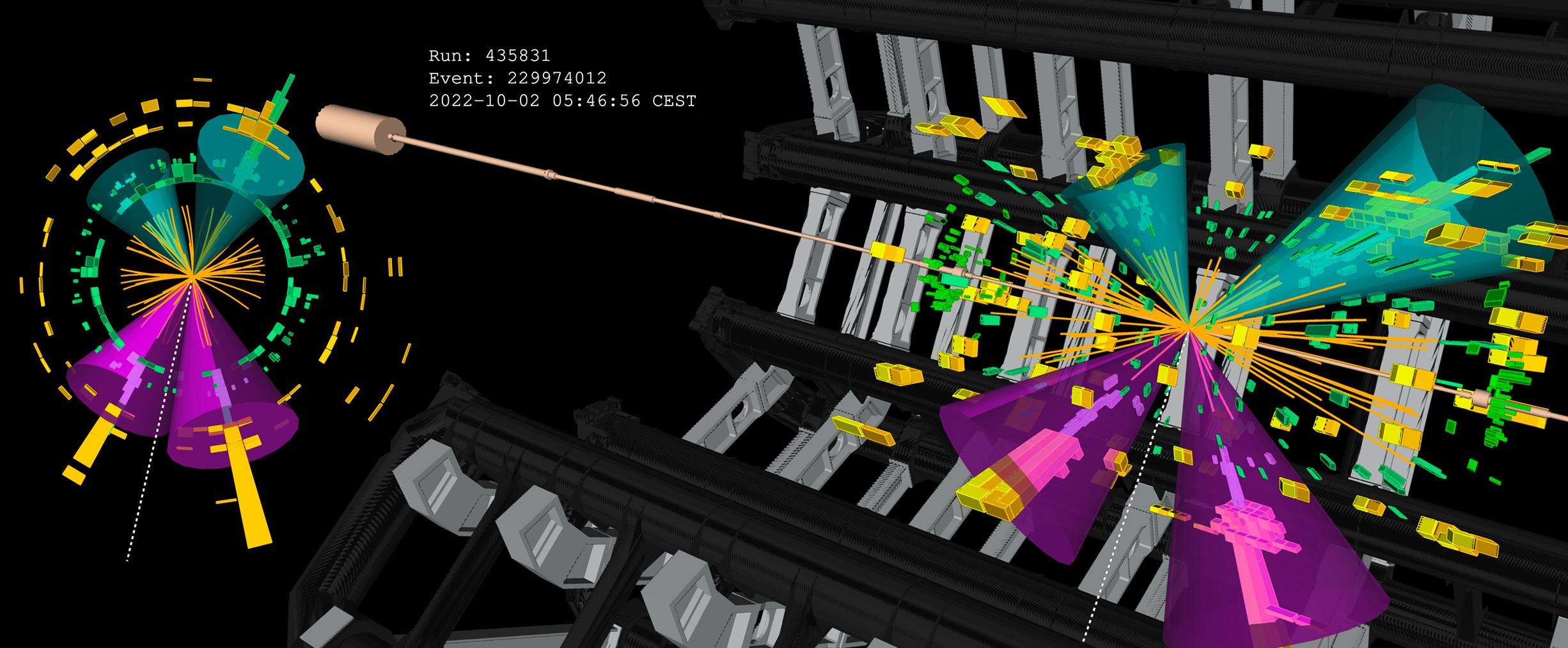
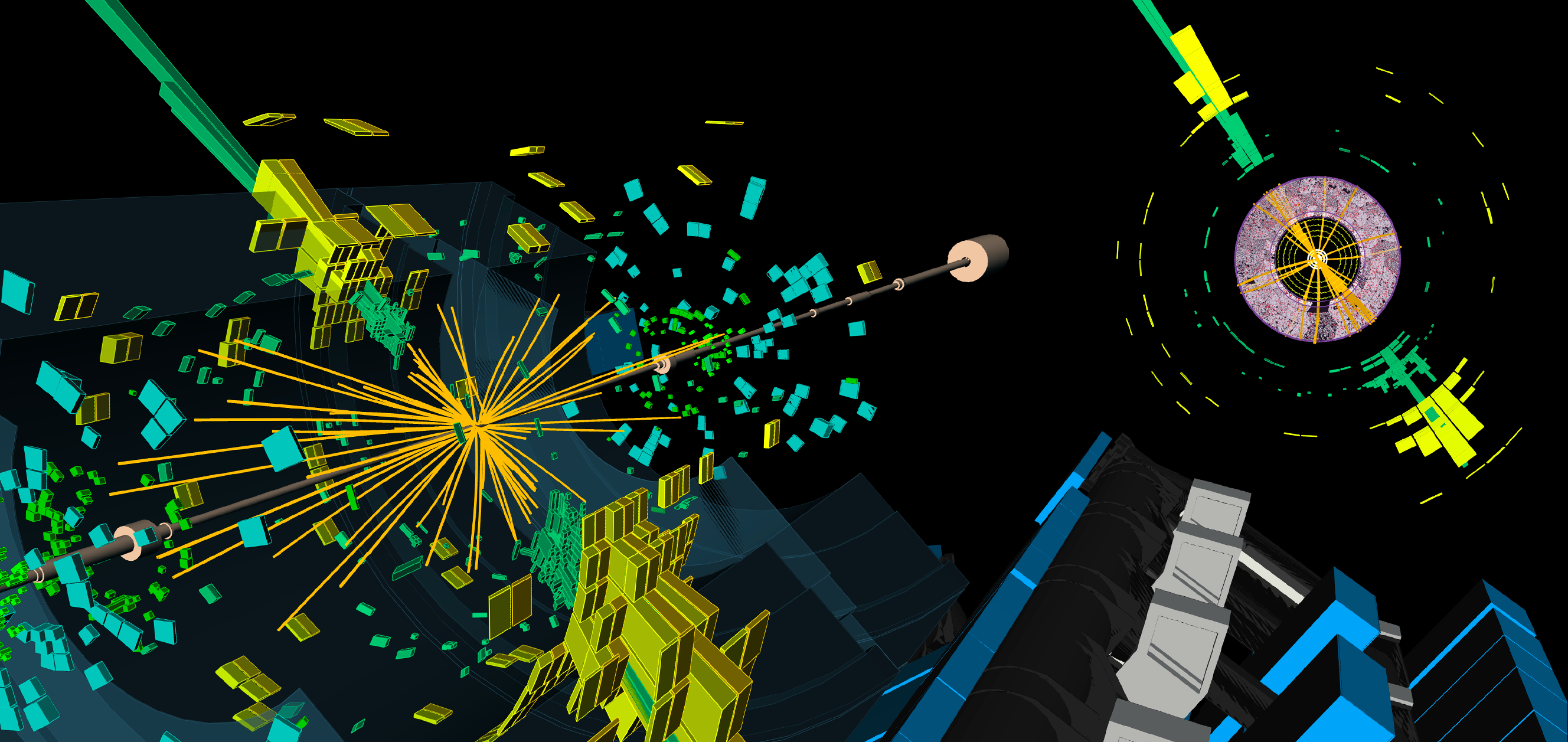
Despite the potential, evidence of this process has eluded physicists. Out of the roughly 60,000 Higgs bosons produced daily at the LHC presently, only 30 have transverse momentum in excess of 450 GeV. This low yield requires large datasets and makes the most abundant Higgs-boson decay mode, into a pair of bottom quarks, the best channel for study. This decay leaves a distinct signature in the experiment, characterised by two energetic “jets” of particles. At very high energies, the two b-quarks originating from the Higgs boson are produced so close together that they appear as a single large-radius jet, balanced by a second “recoil” jet from momentum conservation (see event display).
However, this Higgs-boson signal sits on top of a background originating from strong-force interactions that is 50,000 larger. Extracting the signal therefore requires not only very large datasets, but also new reconstruction tools and signal-selection techniques.
At the Recontres de Moriond conference, the ATLAS Collaboration presented the first evidence of this process, examining 301 fb-1 of data collected during LHC Run 2 (2015-2018) and the first three years of Run 3 (2022-2024). During this period, the performance of key detector components – in particular the thin silicon pixel detector closest to the proton beam, which is critical to identifying heavy bottom quarks – evolved due to radiation damage and had to be carefully modelled.
The new ATLAS result finds the first evidence of Higgs bosons at high transverse momentum from the analysis of 301 fb-1 of data, collected during LHC operation from 2015 to 2024.

ATLAS researchers employed new transformer-based neural networks to improve the isolation of the subtle Higgs signal from background and the measurement of the Higgs boson jet. Originally developed for language translation, these algorithms have since enabled breakthroughs from protein folding in drug discovery to analyses spanning the smallest particles and the largest cosmic structures, demonstrating unprecedented pattern-recognition power across science. In ATLAS, the challenge of jet reconstruction is different but mathematically similar, as a single jet can contain nearly 100 particles with strongly correlated trajectories and energies. The transformer network architecture resolves these correlations by combining these tracks into a global representation of the jet, which is used to classify it as signal or background and to sharpen the mass and transverse momentum resolution in the analysis.
The use of these tools contributed to an overall improvement in analysis sensitivity of a factor of seven to ten compared to the first inclusive ATLAS search for Higgs bosons at high transverse momentum, published in 2022 and based on approximately half the amount of data. As a result, physicists reported an excess of more than 2000 events observed in the Higgs-boson mass region (see Figure 1), corresponding to a significance of 3.8 standard deviations over the background-only hypothesis. This is the first evidence at the LHC for Higgs-boson production at high transverse momentum (above 450 GeV). The measured rate is consistent with Standard Model predictions, and extends earlier studies in other channels.
This result and the associated analysis techniques establish a foundation for future studies using the full Run-3 dataset and, in the longer term, the much larger datasets expected from the High-Luminosity LHC. Studies of Higgs-boson production at high transverse momentum are unique to hadron colliders, and the sensitivity achieved by the ATLAS and CMS Collaborations will be crucial in the exploration of physics beyond the Standard Model with the Higgs boson. Such results are part of the long-term physics legacy of the LHC and will stay in the textbooks for a very long time.
Learn more
- Evidence of Higgs boson inclusive production at high transverse momentum decaying to a pair of b-quarks with the ATLAS detector (arXiv:2603.19369, see figures)
- Constraints on Higgs boson production with large transverse momentum using H→bb¯ decays in the ATLAS detector (Phys. Rev. D 105 (2022) 092003, arXiv:2111.08340, see figures)
- Measurement of the associated production of a Higgs boson decaying into b-quarks with a vector boson at high transverse momentum in proton-proton collisions at 13 TeV with the ATLAS detector (Phys. Lett. B 816 (2021) 136204, arXiv:2008.02508, see figures)
- Moriond EW presentation by Fabio Cerutti: Experimental Summary
- Moriond QCD presentation by Henri Bachacou: Higgs cross section and couplings measurements at ATLAS and CMS
- Transforming bottom-jets: machine learning for improved bottom-jets measurements, Physics Briefing, July 2024
- ATLAS Pixel detector readies to tackle Run 3, Physics Briefing, July 2022
- Studying the Higgs boson in its most common – yet uncommonly challenging – decay channel, Physics Briefing, December 2020