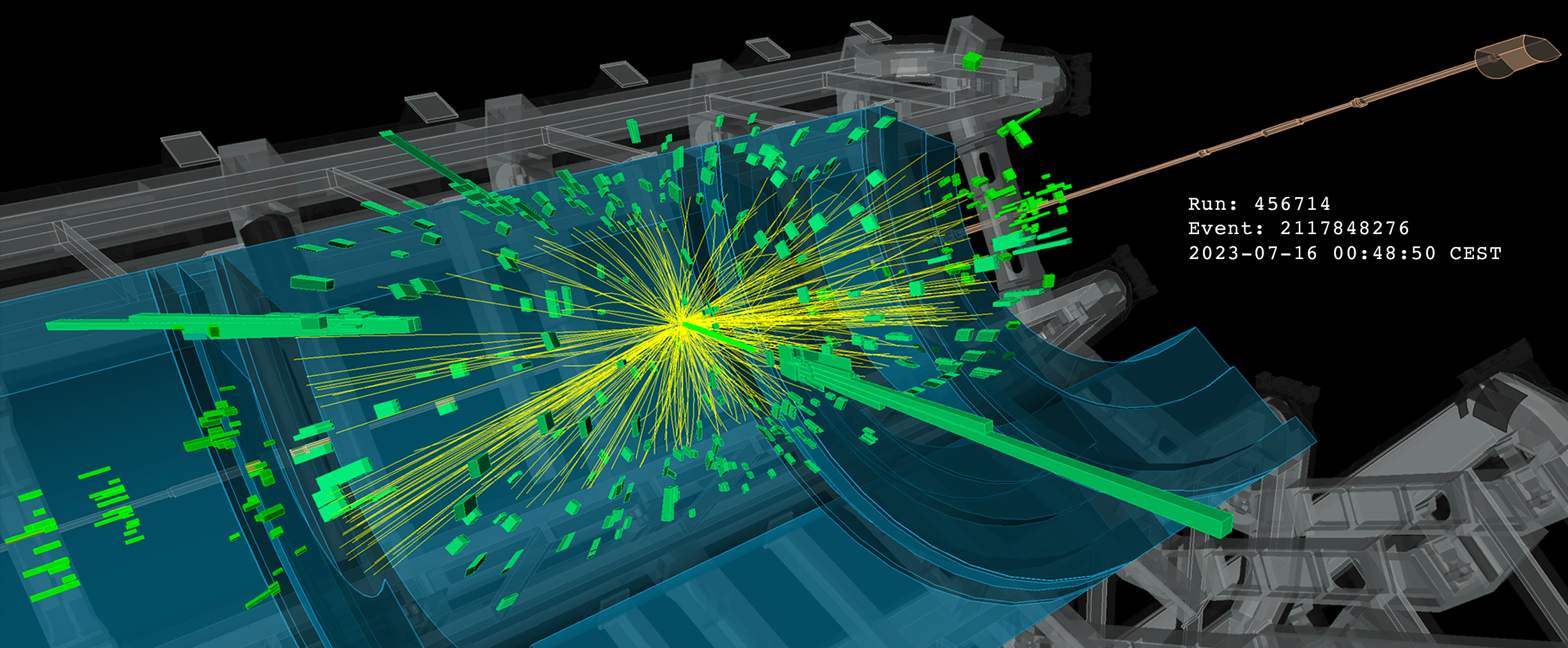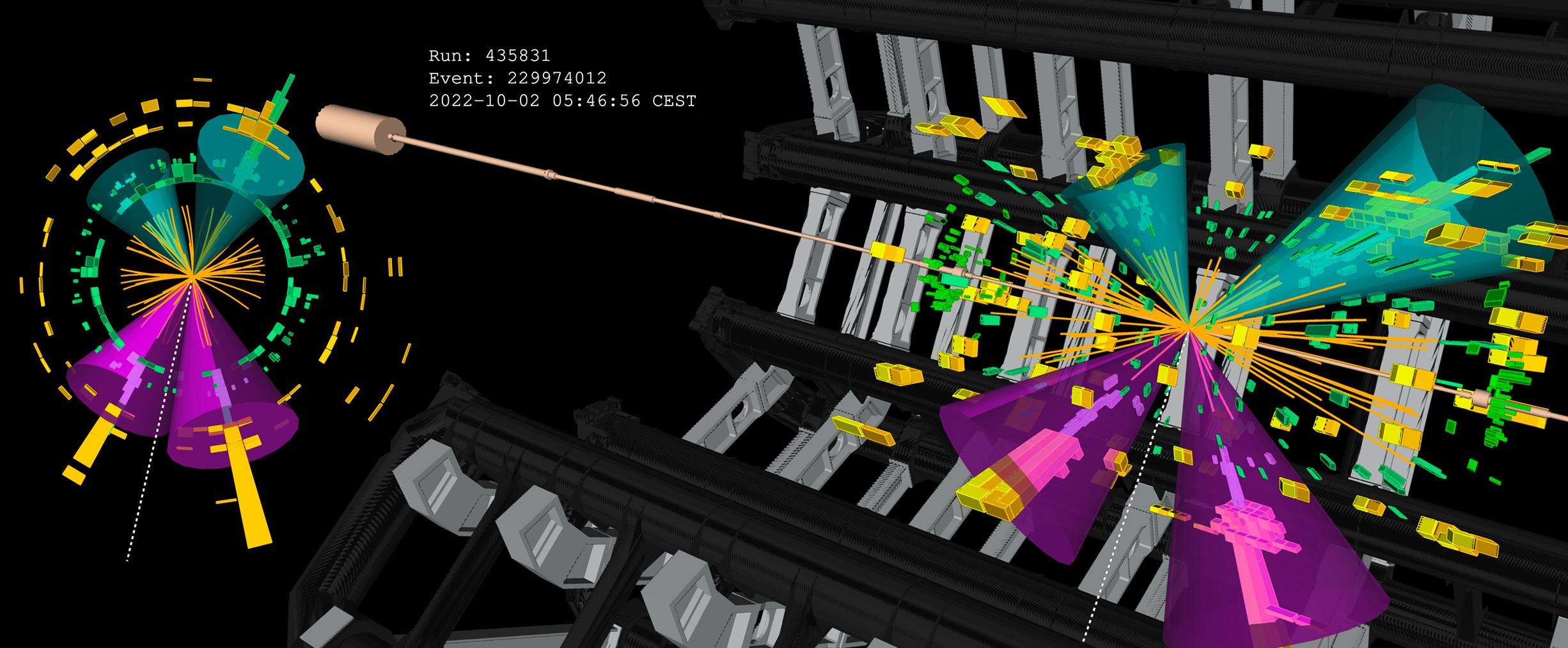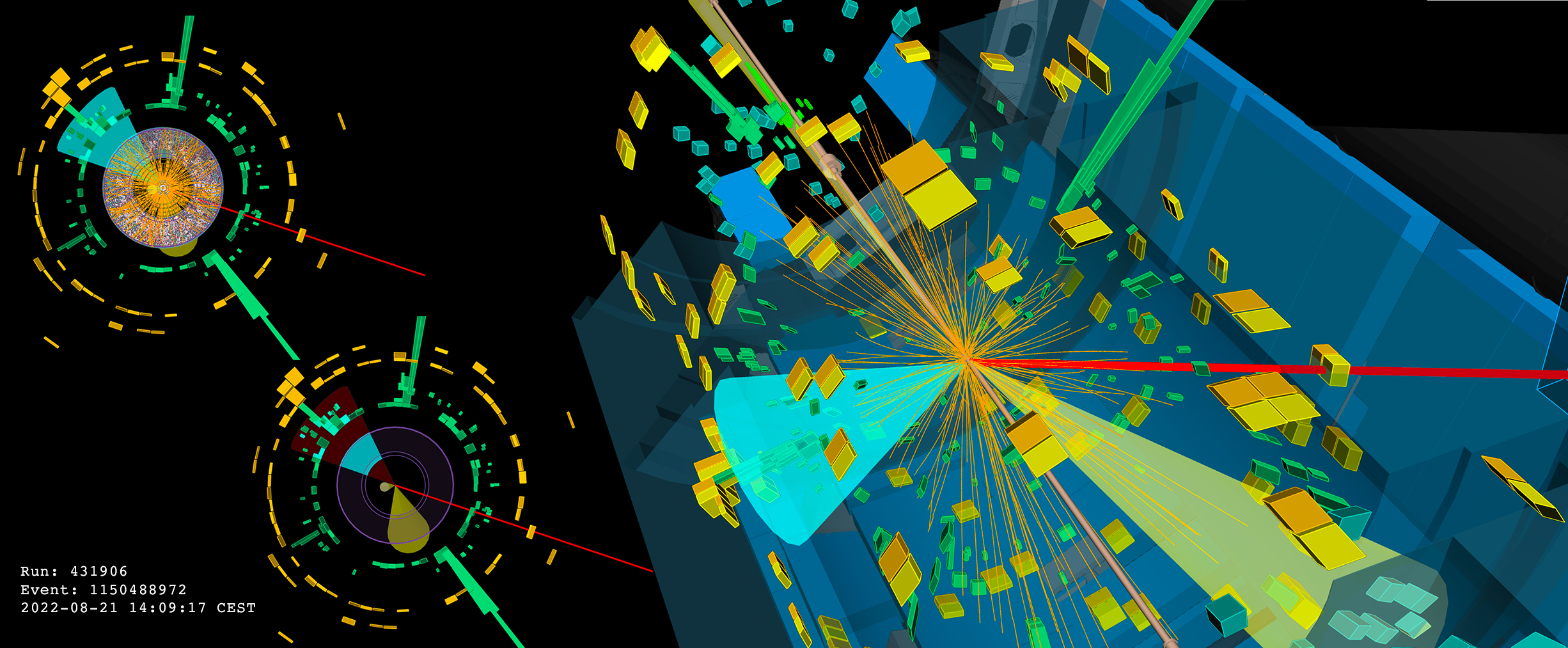
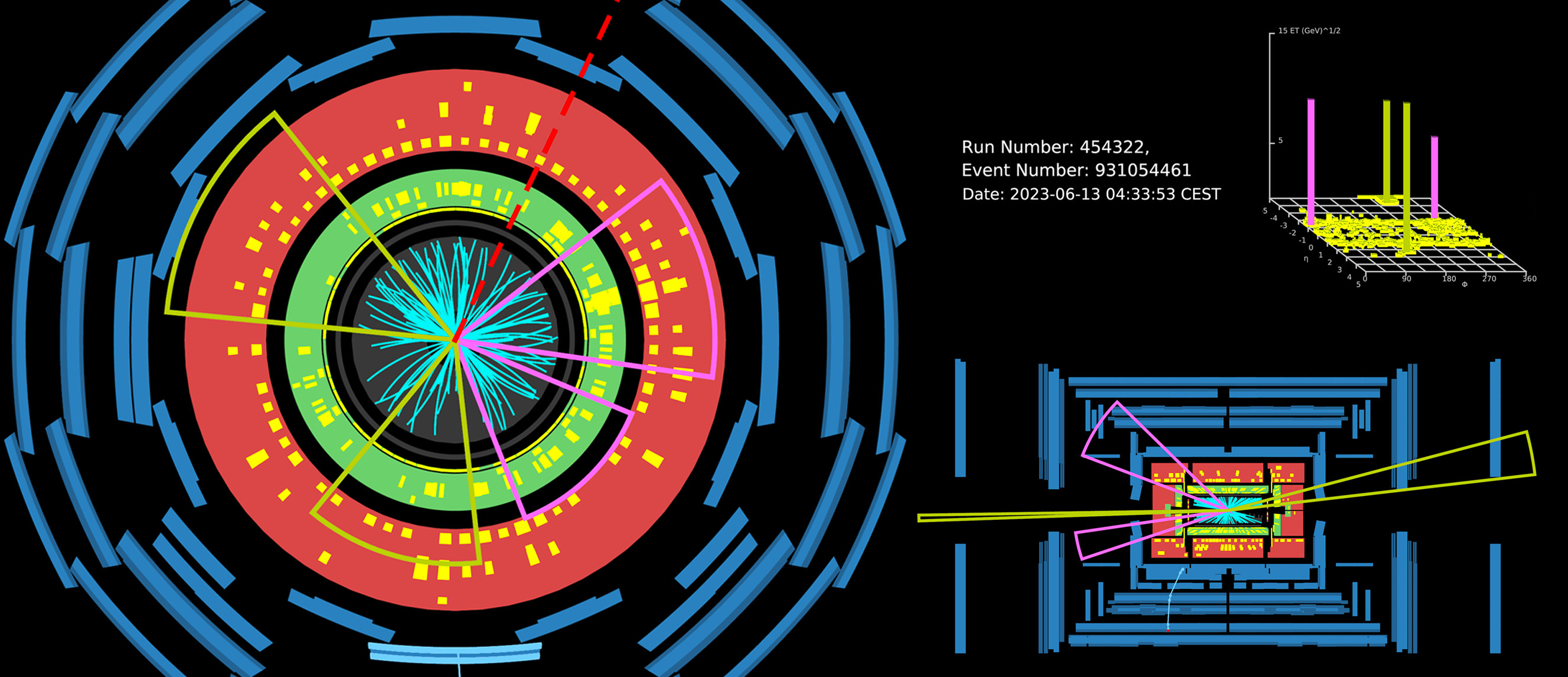
ATLAS extends Higgs boson studies via vector boson fusion into beauty and charm
26 March 2026 | By
An invisible field fills the Universe, giving mass to fundamental particles and shaping the building blocks of matter – the Higgs field. The Higgs boson is its observable manifestation and a cornerstone of the Standard Model. By studying it with increasing precision, physicists are not only refining their understanding of the current theory but also searching for new phenomena that extend beyond it. Such effects may appear as subtle deviations in rare or difficult-to-measure Higgs processes.
Two new results from the ATLAS Collaboration push into this challenging territory, improving the sensitivity to Higgs-boson decays to bottom (H→bb) and charm quarks (H→cc). Though most Higgs bosons transform into quark-antiquark pairs – with H→bb making up about 58% of all decays, and H→cc accounting for 3% – these processes are notoriously difficult to study in hadron colliders. Bottom and charm quarks produce collimated sprays of particles called “jets” – the most common signature observed in the ATLAS experiment, produced in huge numbers via strong-force interactions. Isolating a Higgs signal amid this background is a challenging task, particularly for the H→cc decay, as charm jets are significantly more difficult to identify than their bottom-quark counterparts.
To tackle this challenge, researchers focused on Higgs bosons produced via the fusion of two W or Z bosons – a process called vector boson fusion (VBF). Although this production mode accounts for just 7% of Higgs bosons, compared to 87% from the dominant gluon fusion production mode, it can leave a distinctive signature in the experiment: two energetic jets produced in the forward regions of the experiment with a large angular separation. This feature made it easier for researchers to separate the signal from background and is used in both analyses.

Looking for a light
For their first new result, ATLAS physicists looked for a (literal) beacon of light! In roughly 1% of VBF Higgs events, the Higgs boson is accompanied by a high-energy photon. The dominant multi-jet background processes rarely produce such a “shine”, making this a clean signature for the event-selection algorithm ("trigger") to identify collision events.
Building on previous work, the ATLAS Collaboration analysed LHC Run-2 data (2016-2018) to search for VBF H→bb produced in association with a photon. To maximise their sensitivity, physicists trained a neural network to distinguish signal events from background events based on the kinematics of the collisions. Neural networks assign each event a score between 0 and 1, reflecting how signal-like it appears. In this analysis, rather than selecting only the highest-scoring events, physicists fit the distribution of neural-network scores directly and used the mass of the two jets originating from bottom quarks to define the signal and control regions (see Figure 1).
Researchers measured a Higgs-boson signal strength of μbb = 0.2 ± 0.7, corresponding to an observed significance of 0.3 standard deviations (1.5 expected). Although this accounts for just 20% of the expected rate, the measurement is fully compatible with the Standard Model.
The ATLAS Collaboration finds evidence of the Higgs boson in one of the “noisiest” environments in which to study the particle.

Searching for subtle patterns
But what happens when there is no beacon? For their second result, physicists searched without the help of a guiding photon, instead relying on subtle patterns in the event topology and a dedicated trigger. They focused on the characteristic VBF signature described above, a strategy that enabled searches for both VBF H→bb and VBF H→cc.
The H→cc search used a mix of LHC Run-2 and Run-3 data (2018, 2022 and 2023). No significant excess above the background was observed. At the 95% confidence level, researchers set an upper limit of 41 times the Standard Model prediction for the H→cc rate in this channel (28 times expected). When combined with an earlier ATLAS search for H→cc (via VH production), a direct constraint was set on the interaction strength of the charm quark and Higgs boson, κc, to be less than 4.7 times the Standard Model value (3.9 expected).
For their search for H→bb, researchers focused on Run-3 data from 2022 and 2023. They measured a Higgs-boson signal strength of μbb = 0.97 ± 0.57 – right where one would expect a signal consistent with the Standard Model (see Figure 2). The measurement was combined with previous Run-2 results as well as the H→bb search described above, the signal strength reached an observed combined significance of 3.2 standard deviations (3.6 expected). This constitutes the first evidence for VBF H→bb in a fully hadronic final state.
The ATLAS Collaboration has now established evidence of the Higgs boson in one of the “noisiest” environments in which to study the particle. Higgs research has evolved, with focus shifting from the most accessible signatures to increasingly subtle and challenging measurements. If new physics is to be uncovered at the LHC, it may appear as deviations in precisely such studies.
Learn more
- Search for Higgs bosons produced in association with a high-energy photon via vector-boson fusion and decaying to a pair of b-quarks in the ATLAS detector (arXiv:2509.14005, see figures)
- Search for H→cc and measurement of H→bb in vector-boson fusion production with the ATLAS Detector (arXiv:2511.21911, see figures)
- Measurements of WH and ZH production with Higgs boson decays into bottom quarks and direct constraints on the charm Yukawa coupling in 13TeV pp collisions with the ATLAS detector (JHEP 04 (2025) 075, arXiv:2410.19611, see figures)
- Search for Higgs boson production in association with a high-energy photon via vector-boson fusion with decay into bottom quark pairs at 13 TeV with the ATLAS detector (JHEP 03 (2021) 268, arXiv:2010.13651, see figures)
- The beauty and the charm of the Higgs boson, Physics Briefing, July 2024
- Studying the Higgs boson in its most common – yet uncommonly challenging – decay channel, Physics Briefing, December 2020